
How shippers choose logistics providers starts with people rather than search. In a 2022 survey of 100 senior logistics buyers, a colleague's recommendation was the most cited reason for contacting a new provider, at 23% (Logistics Marketing Advisors, Jun 2022). Reliability then decides the choice: 89% of shippers named it among their most important factors when choosing a motor carrier in 2025, ahead of price at 81% (Inbound Logistics, Sep 2025).
The figures below cover discovery, first contact, trust, collaboration, operational risk and final selection. Each one names the population, the survey year and the organisation that ran the survey, and links to its report or public summary. The samples are American, global or of unstated geography, and none measures European road freight or dangerous goods buyers, so read them as direction rather than a European benchmark.
Key Takeaways
- A colleague's recommendation was the most cited trigger for contacting a new logistics provider, at 23% (Logistics Marketing Advisors, Jun 2022).
- 77% of senior logistics buyers preferred first contact by email, and none preferred social media (Logistics Marketing Advisors, Jun 2022).
- 74% of logistics buyers did not mind sharing contact details to download useful content (Logistics Marketing Advisors, Jun 2022).
- 29% of logistics buyers relied on print magazines in 2022, against 70% in 2014 (Logistics Marketing Advisors, Jun 2022).
- 89% of shippers named reliability among their most important factors when choosing a motor carrier (Inbound Logistics, Sep 2025).
- 81% of shippers named price among their most important carrier selection factors, ahead of customer service at 70% (Inbound Logistics, Sep 2025).
- 78% of shippers rated service as more important than price when measuring 3PL performance (Inbound Logistics, Jul 2026).
- Poor customer service was the most cited reason for a failed 3PL partnership, named by 33% of shippers (Inbound Logistics, Jul 2026).
- 88% of shippers called their 3PL relationships successful in the 2026 Annual 3PL Study (University of Tennessee GSCI, 2026 3PL Study, Jun 2026).
- Only 5% of shipper and 3PL relationships were truly strategic, though 55% of shippers described theirs that way (University of Tennessee GSCI, 2026 3PL Study, Jun 2026).
- Trust and open communication rank first in what shippers want from a strategic 3PL partnership (Penske Logistics, 2027 3PL Study summary, Oct 2026).
- Cargo theft and security concerns rose from 12% of shippers in 2023 to 48% in 2025 (Inbound Logistics, Sep 2025).
- About 69% of 3PLs were extremely satisfied with their freight theft defences, against 36% of shippers (Penske Logistics, 2027 3PL Study summary, Oct 2026).
- Reliability and accuracy made up 32.1% of contract logistics selection criteria chosen, price 20.5% (Ti Insight, Jan 2024).
How do shippers find logistics providers they do not use yet?
Mostly through people. In buyer research, a colleague's recommendation or a reputation for the exact service needed prompts more first contacts than search, events or advertising, and buyers follow the market through trade news sites, newsletters and peers.
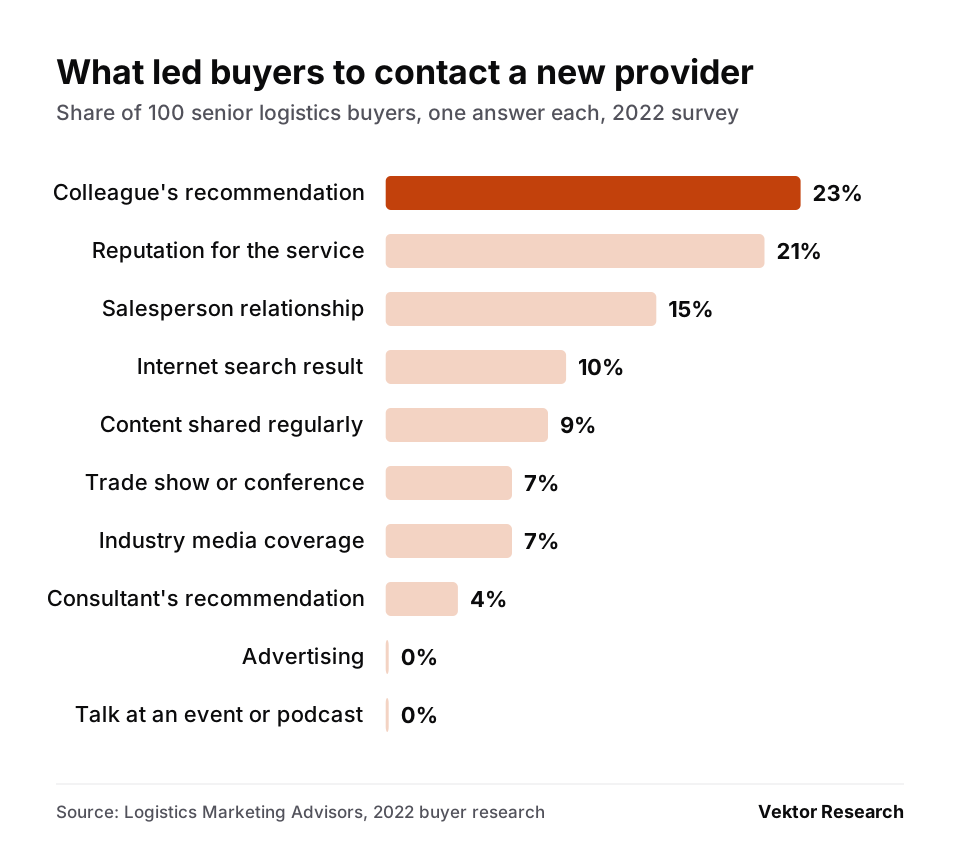
What makes a logistics buyer contact a new provider?
A recommendation or a reputation for the exact service comes first. Search results and shared content follow some way behind.
- 23% of senior logistics buyers said a colleague's recommendation led them to contact a provider they did not already use, the most cited answer in 2022 (Logistics Marketing Advisors, Jun 2022).
- 21% of buyers were prompted by a strong reputation for the service or product they needed in 2022 (Logistics Marketing Advisors, Jun 2022).
- 15% of buyers reached out because of a relationship with a salesperson in 2022 (Logistics Marketing Advisors, Jun 2022).
- 10% of buyers made first contact after an internet search result in 2022 (Logistics Marketing Advisors, Jun 2022).
- 9% of buyers acted on useful content the company had regularly shared with them in 2022 (Logistics Marketing Advisors, Jun 2022).
- 7% of buyers named a trade show or conference meeting, and another 7% reading about the provider in industry media (Logistics Marketing Advisors, Jun 2022).
- No buyer in the 2022 survey named advertising, or hearing a provider speak at a conference or on a podcast, as the trigger (Logistics Marketing Advisors, Jun 2022).
Which information sources do logistics buyers rely on?
Industry news sites and online newsletters lead, followed by colleagues and then providers themselves. Print magazines have lost most of the reach they had in 2014.
- Logistics industry websites and online newsletters were the information source the 100 buyers relied on most in 2022 (Logistics Marketing Advisors, Jun 2022).
- Colleagues and peers were the second most relied on source in 2022, ahead of logistics providers (Logistics Marketing Advisors, Jun 2022).
- 29% of buyers relied on logistics print magazines in 2022, against 70% in the first survey in 2014 (Logistics Marketing Advisors, Jun 2022).
- 78% of buyers agreed in 2022 that they log into LinkedIn at least once a week, against 50% in 2016 (Logistics Marketing Advisors, Jun 2022).
- Webinars and podcasts both gained ground against the 2020 survey, though podcasts stayed the least relied on source (Logistics Marketing Advisors, Jun 2022).
Channel and budget figures for logistics marketing as a whole are collected in logistics marketing statistics.
How did discovery triggers change between 2020 and 2022?
Reputation nearly doubled as a trigger while search and events lost ground. The two waves are separate samples, and the 2022 report does not state the 2020 sample size.
- Colleague recommendations fell from 27% to 23% of first contacts between the 2020 and 2022 surveys but stayed the most cited trigger (Logistics Marketing Advisors, Jun 2022).
- A strong reputation for the needed service rose from 11% to 21% of first contacts between 2020 and 2022 (Logistics Marketing Advisors, Jun 2022).
- Internet search results fell from 15% to 10% of first contacts between 2020 and 2022 (Logistics Marketing Advisors, Jun 2022).
- Trade show and conference meetings fell from 11% to 7% of first contacts between 2020 and 2022 (Logistics Marketing Advisors, Jun 2022).
- Useful content shared regularly rose from 5% to 9% of first contacts between 2020 and 2022 (Logistics Marketing Advisors, Jun 2022).
How do logistics buyers want providers to make first contact?
By email, or through useful content they find themselves. A majority in the 2022 survey did not want calls from salespeople they did not know, yet three in four were willing to register for useful content.
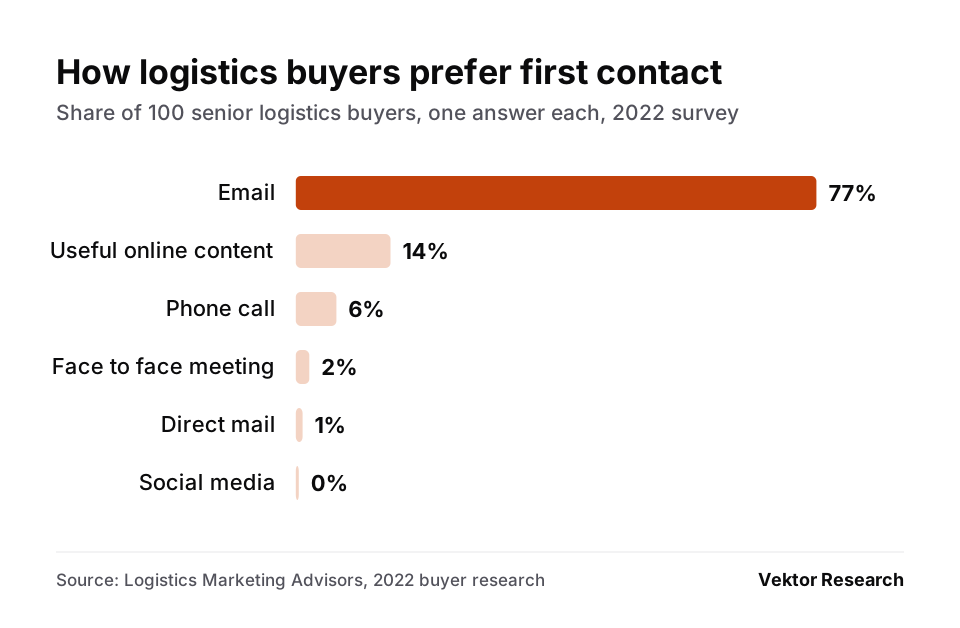
Which contact channel do logistics buyers prefer?
Email, by a wide margin, as in every edition since 2014. Phone, face to face meetings, post and social media together account for fewer than one buyer in ten.
- 77% of senior logistics buyers preferred to be contacted by email in 2022 (Logistics Marketing Advisors, Jun 2022).
- 14% of buyers preferred useful online content in 2022 (Logistics Marketing Advisors, Jun 2022).
- 6% of buyers preferred a phone call in 2022 (Logistics Marketing Advisors, Jun 2022).
- 2% of buyers preferred a face to face meeting, and 1% direct mail (Logistics Marketing Advisors, Jun 2022).
- No buyer in the 2022 survey preferred first contact through social media (Logistics Marketing Advisors, Jun 2022).
How do buyers react to cold calls and sales emails?
Most do not want calls from strangers, but an email pitch is not a dead end. About a third say they never answer one.
- 55% of buyers agreed in 2022 that logistics salespeople they do not know should never call them, against 48.5% in 2016 (Logistics Marketing Advisors, Jun 2022).
- 36% of buyers agreed in 2022 that they never respond to an email sales pitch from a logistics company, while 64% disagreed (Logistics Marketing Advisors, Jun 2022).
- The share who never respond to email sales pitches rose from 23% in 2016 to 36% in 2022 (Logistics Marketing Advisors, Jun 2022).
Will buyers give contact details in exchange for content?
Mostly yes. Three in four buyers did not mind registering for useful content in 2022, and only about a third preferred video to written material.
- 74% of buyers agreed in 2022 that they do not mind providing contact information to download useful content, up from 67% in 2020 (Logistics Marketing Advisors, Jun 2022).
- 35% of buyers agreed in 2022 that they prefer watching a video to reading a blog post or other written information (Logistics Marketing Advisors, Jun 2022).
- 68% of buyers agreed in 2022 that logistics companies should stop printing promotional brochures and rely on electronic files (Logistics Marketing Advisors, Jun 2022).
- 51% of buyers agreed in 2022 that they pay attention to print advertisements in the trade magazines they read, against 75% in 2016 (Logistics Marketing Advisors, Jun 2022).
Wider figures on the channels logistics firms market through are in logistics marketing statistics.
What makes shippers trust a logistics provider?
Service delivered as promised. Shippers rate service above price whenever a survey forces the choice, and poor service is the reason most often given when a 3PL partnership fails or a provider is replaced.
Do shippers value service over price?
Yes, whenever a survey forces the choice. The share choosing service was 72% in 2025 and 78% in 2026.
- 78% of shipper respondents rated service as more important than price when measuring 3PL performance in the 2026 survey (Inbound Logistics, Jul 2026).
- Shippers chose service over price by 72% to 28% in the 2025 survey (Inbound Logistics, Jul 2025).
- 67% of nearly 100 shippers named service level and reliability as the factors that matter most when choosing a freight partner in 2025, against 10% naming price (Denim and Peerless Research Group, Jun 2025).
Why do shippers end a relationship with a provider?
Poor service leads every survey that asks. Missed expectations come second in the 3PL surveys, and price increases second in the contract logistics survey.
- Poor customer service was the most cited reason for a failed 3PL partnership in the 2026 survey, named by 33% of shippers, ahead of failed expectations at 29% (Inbound Logistics, Jul 2026).
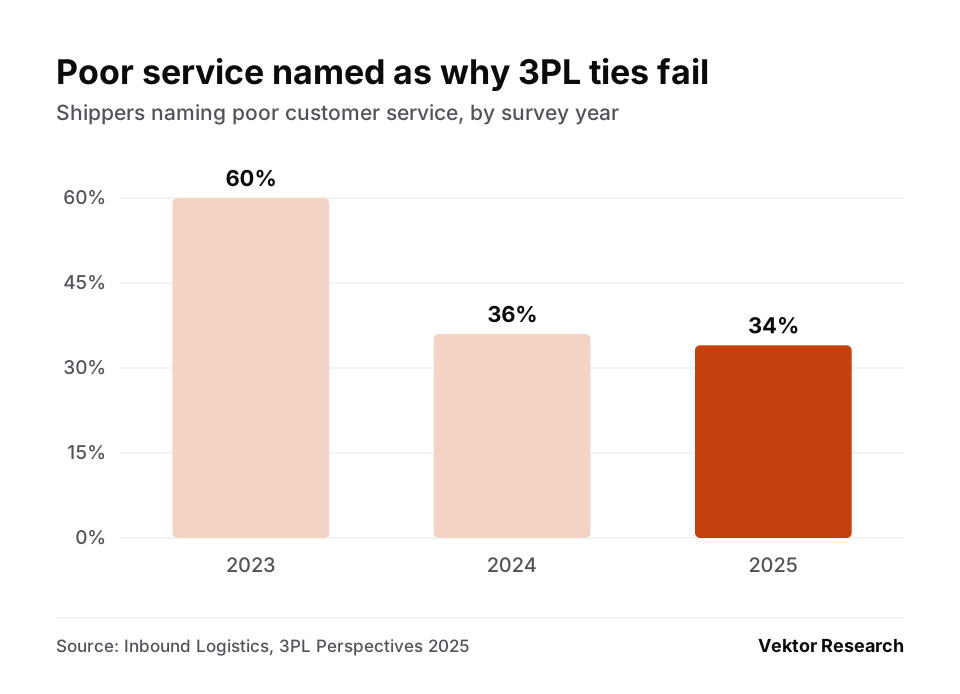
- In the 2025 survey, 34% of shippers named poor customer service, 28% failed expectations and 22% cost as the main reason a 3PL partnership failed (Inbound Logistics, Jul 2025).
- The share naming poor customer service as the main failure reason fell from 60% in 2023 to 36% in 2024 (Inbound Logistics, Jul 2025).
- Contract logistics buyers named poor quality of service (33.0% of responses) and a price increase (28.3%) as the likeliest reasons to change provider in 2023 (Ti Insight, Jan 2024).
- Missed deliveries, poor communication and invoicing issues were the most common reasons shippers left a broker or carrier in the 2025 survey (Denim and Peerless Research Group, Jun 2025).
What do shippers say a strategic relationship rests on?
Trust and open communication, ahead of operational excellence and agility. The public summary of the 2027 study gives the order but not the percentages.
- Trust and open communication ranked first among the components shippers named for a strategic 3PL partnership in the 2027 study, followed by operational excellence and agility (Penske Logistics, 2027 3PL Study summary, Oct 2026).
- The 2027 study describes shipper and 3PL relationships as increasingly focused on service, innovation, agility and long term value (NTT DATA, 2027 3PL Study, Oct 2026).
- 30% of shippers named contact from unrecognised third parties as their main frustration with collections and invoicing in 2025, and 27% named tone or unprofessional language (Denim and Peerless Research Group, Jun 2025).
How do shippers and 3PLs work together once a contract is signed?
Mostly well, by their own account, but rarely as deep partners. Nearly nine in ten shippers call their 3PL relationships successful, while only a small share meet the study's own test of a strategic relationship.
How many shippers call their 3PL relationships successful?
Close to nine in ten. Providers rate their partnerships higher still, and half of shippers are cutting the number of 3PLs they use.
- 88% of shippers in the 2026 Annual 3PL Study said their 3PL relationships were successful (University of Tennessee GSCI, 2026 3PL Study, Jun 2026).
- 100% of 3PL respondents in the 2026 study reported successful partnerships (NTT DATA, 2026 3PL Study, Oct 2025).
- 50% of shippers in the 2026 study were consolidating the number of 3PLs they use (University of Tennessee GSCI, 2026 3PL Study, Jun 2026).
- 33% of shippers said they should stick to one 3PL, 27% preferred more than one and 40% said it depends, in the 2025 survey (Inbound Logistics, Jul 2025).
How strategic are shipper and 3PL relationships?
Less than shippers think. The 2026 study found a wide gap between how shippers describe their relationships and how many meet its definition of strategic.
- Only 5% of shipper and 3PL relationships were truly strategic in the 2026 study, although 55% of shippers described theirs that way (University of Tennessee GSCI, 2026 3PL Study, Jun 2026).
- In the 2027 study, 39% of shipper responses connected their outsourced logistics spending to strategic partnerships with 3PLs (Penske Logistics, 2027 3PL Study summary, Oct 2026).
- 3PLs in the 2027 study linked 54% of their revenue to strategic partnerships with customers (Penske Logistics, 2027 3PL Study summary, Oct 2026).
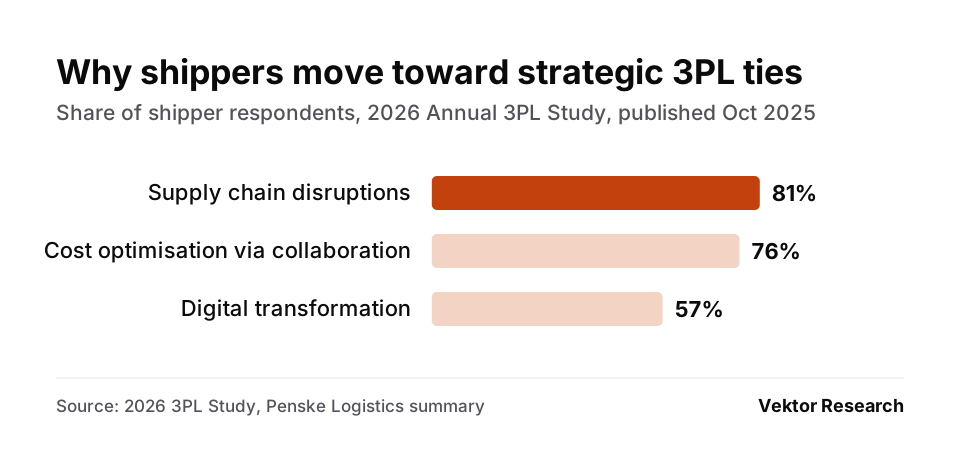
- Shippers in the 2026 study named supply chain disruptions (81%), cost optimisation through collaboration (76%) and digital transformation (57%) as drivers of strategic partnerships (Penske Logistics, 2026 3PL Study summary, Oct 2025).
- 3PLs in the 2026 study named demand for end to end visibility (61%), customised and value added services (61%) and cost optimisation through collaboration (56%) (Penske Logistics, 2026 3PL Study summary, Oct 2025).
Which contract terms hold shippers and 3PLs together?
Service level agreements are the most common link, and two thirds of shippers also use guaranteed volume or capacity. Just over half do not rebid business when a contract ends.
- Service level agreements were the most common way shippers and 3PLs connect in the 2026 study (Penske Logistics, 2026 3PL Study summary, Oct 2025).
- Shippers in the 2026 study also used guaranteed volume or capacity (67%), flexible terminations (62%) and contract extensions (57%) (Penske Logistics, 2026 3PL Study summary, Oct 2025).
- A little over half of shippers in the 2026 study said they do not rebid business at the end of a contract (Penske Logistics, 2026 3PL Study summary, Oct 2025).
- 51% of contract logistics buyers had a hybrid contract in 2023 (Ti Insight, Jan 2024).
- 73.5% of contract logistics buyers had contracts running two to five years in 2023 (Ti Insight, Jan 2024).
Which operational risks shape how shippers choose providers?
Cost and capacity come first, with cargo theft rising fast. Shippers in 2025 ranked transport costs as their main challenge, and the share worried about cargo theft quadrupled in two years.
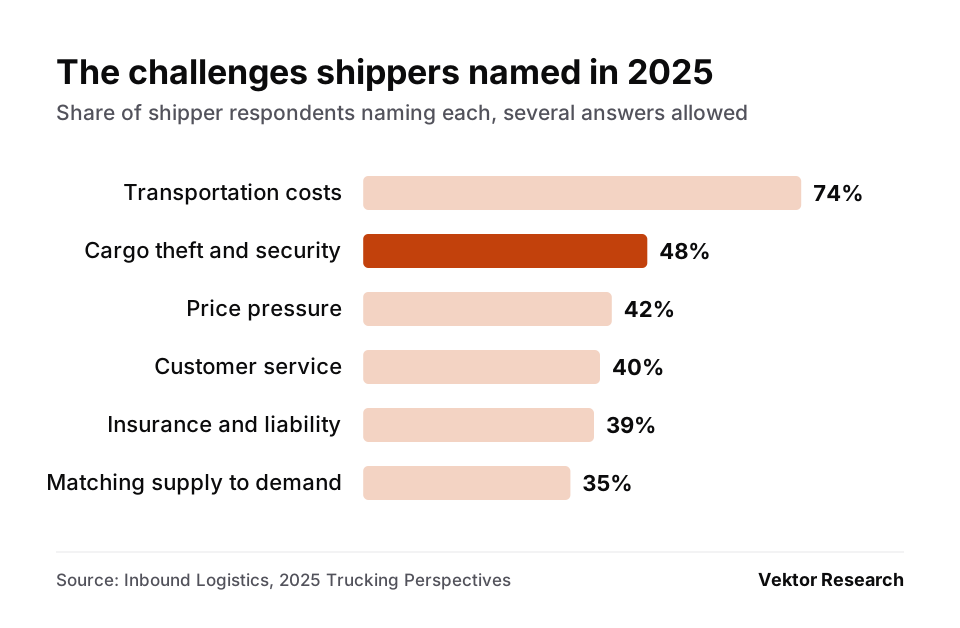
Which challenges do shippers rank highest in 2025 and 2026?
Transport cost leads the motor freight survey, while the 3PL survey put implementing AI first. The two are separate Inbound Logistics samples from different years.
- 74% of shippers named transportation costs as a challenge in 2025, the most cited answer for the third year running (Inbound Logistics, Sep 2025).
- 42% of shippers named price pressure from competitors or customers, 40% customer service, 39% rising insurance costs and liabilities and 35% matching supply to demand in 2025 (Inbound Logistics, Sep 2025).
- 84% of shippers reported carrier rate increases apart from fuel surcharges in 2025 (Inbound Logistics, Sep 2025).
- 54% of shippers said they had not experienced a truck capacity shortage in 2025 (Inbound Logistics, Sep 2025).
- 73% of shipper respondents named implementing AI as a challenge in the 2026 survey, ahead of cutting transport costs at 54% and improving customer service at 52% (Inbound Logistics, Jul 2026).
How exposed do shippers feel to cargo theft and freight fraud?
More than before, and less confident in their defences than their providers. Theft has moved from a minor to a major concern in shipper surveys.
- Cargo theft and security concerns rose from 12% of shippers in 2023 to 48% in 2025, the second most cited challenge (Inbound Logistics, Sep 2025).
- About 69% of 3PLs in the 2027 study were extremely satisfied with their technology defences against freight theft, against 36% of shippers (Penske Logistics, 2027 3PL Study summary, Oct 2026).
- 3PLs put more emphasis on cybersecurity risk than shippers in the 2027 study, by 42% to 29% (Penske Logistics, 2027 3PL Study summary, Oct 2026).
- Transportation capacity disruptions were the main concern of shippers and 3PLs in the 2027 study, by an overwhelming margin (Penske Logistics, 2027 3PL Study summary, Oct 2026).
How do shippers build resilience into their provider base?
By spreading volume and keeping the network flexible. Buyers plan more sourcing options and, on balance, more outsourcing.
- Shippers in the 2027 study countered disruption through network flexibility, including multi carrier and multimodal strategies, alternative sourcing and inventory buffering (Penske Logistics, 2027 3PL Study summary, Oct 2026).
- 30.1% of contract logistics buyers planned to source from multiple locations in 2023, the most chosen resilience strategy (Ti Insight, Jan 2024).
- Just under 60% of contract logistics buyers expected the share of logistics they outsource to rise in the following year (Ti Insight, Jan 2024).
- More than 20% of logistics buyers said in 2022 that the pandemic had little or no impact on their operations (Logistics Marketing Advisors, Jun 2022).
What decides the final choice of logistics provider?
Reliability first, then price, then service and fit. How large price looks depends heavily on how a survey asks the question, which explains much of the apparent disagreement between studies.
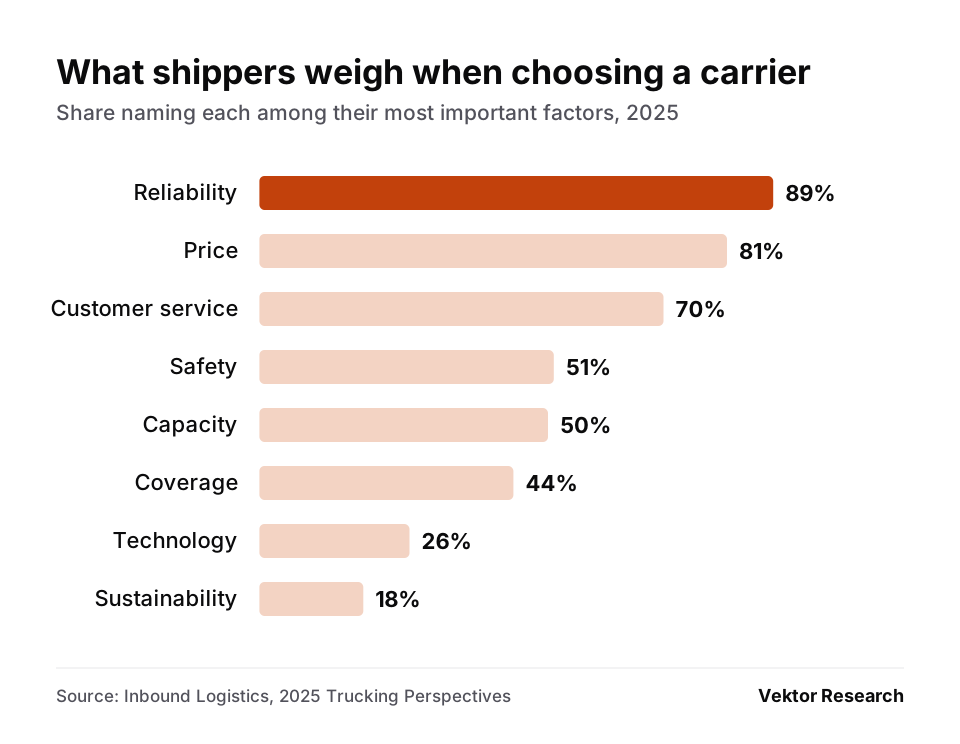
Which factors do shippers weigh when choosing a carrier or 3PL?
Reliability tops both the motor carrier and the contract logistics surveys. Coverage, technology and sustainability trail well behind.
- 89% of shippers named reliability among the most important factors when choosing a motor carrier in 2025 (Inbound Logistics, Sep 2025).
- 81% of shippers named price, 70% customer service, 51% safety and 50% capacity as important carrier selection factors in 2025 (Inbound Logistics, Sep 2025).
- 44% of shippers named coverage, 26% technology and 18% sustainability as important carrier selection factors in 2025 (Inbound Logistics, print edition, Sep 2025).
- Customer service rose 16 points from 2024 to 2025 as a selection factor, while capacity fell 11 points and sustainability 13 points (Inbound Logistics, Sep 2025).
- Reliability and accuracy made up 32.1% of the selection criteria chosen by contract logistics buyers in 2023, price 20.5% and geographic coverage 10.8% (Ti Insight, Jan 2024).
- 56% of shippers rated their carrier and broker relationships as equally important in 2025, while 27% favoured the carrier and 17% the broker (Inbound Logistics, Sep 2025).
What priority do logistics buyers bring to the decision?
Operational excellence and flexibility narrowly lead industry expertise, with cost further back. Very few buyers lead with innovation or technology.
- 24% of senior logistics buyers said operational excellence most closely described their priority when choosing a provider in 2022 (Logistics Marketing Advisors, Jun 2022).
- 23% of buyers chose flexibility as their priority in 2022 (Logistics Marketing Advisors, Jun 2022).
- 21% of buyers chose industry expertise, which the report says buyers in pharma and chemicals put above all else (Logistics Marketing Advisors, Jun 2022).
- 17% of buyers chose cost reduction, the most chosen answer in earlier editions before operational excellence was added as an option in 2022 (Logistics Marketing Advisors, Jun 2022).
- 9% of buyers chose innovation and 3% technology as their priority in 2022 (Logistics Marketing Advisors, Jun 2022).
Why do studies disagree on how much price matters?
Because they ask different questions. Lists that allow several answers put price in most replies, while single choice questions push it far down. Technology swings even more, from 3% as a single priority to 90% as one of several critical elements.
- Price was among the most important carrier selection factors for 81% of shippers when several factors could be chosen in 2025 (Inbound Logistics, Sep 2025).
- 28% of shippers chose price over service when forced to pick one of the two in the 2025 survey (Inbound Logistics, Jul 2025).
- Price took 20.5% of all criteria picked when contract logistics buyers named their three main selection criteria in 2023 (Ti Insight, Jan 2024).
- 17% of buyers named cost as their single priority when choosing a provider in 2022, with one statement allowed per buyer (Logistics Marketing Advisors, Jun 2022).
- Only 10% of shippers listed price among the factors that matter most when choosing a freight partner in 2025 (Denim and Peerless Research Group, Jun 2025).
- 90% of shippers in the 2026 study regarded technological capabilities as among the most critical elements of selecting a 3PL (Penske Logistics, 2026 3PL Study summary, Oct 2025).
- 74% of shippers in the 2026 study said they would switch 3PL providers based on AI capabilities (University of Tennessee GSCI, 2026 3PL Study, Jun 2026).
Budget, channel, email and search benchmarks for logistics marketing sit in logistics marketing statistics.
Methodology and Sources
Every figure comes from the organisation that ran the survey or from the study's own sponsors: a marketing adviser's buyer survey, the university led annual Third Party Logistics Study, Inbound Logistics reader surveys, a Ti Insight procurement survey and a payments vendor's shipper poll. The date in each citation is the publication month; the survey year sits in the sentence, and the claim ledger below lists both. The full 2026 and 2027 Third Party Logistics Study reports sit behind a registration form, so their figures come from the sponsors' public summaries and carry no sample size.
Vendor and magazine surveys measure their own audiences and read as signals, not market averages. No general B2B figure is used as a proxy, and nothing comes from a statistics roundup.
Claim ledger
Each row covers one survey question or study summary and gives the location of its figures.
| Study | Question wording | Geography | Respondents | Fieldwork and publication | Achieved sample | Denominator | Source location |
|---|---|---|---|---|---|---|---|
| Logistics Marketing Advisors, 2022 buyer survey | "When it comes to choosing a logistics product or service provider, which statement best describes your attitude and priority?" | Not stated | Logistics buyers, almost all Director level and above in logistics, supply chain and operations | Survey year 2022, dates not stated; published Jun 2022 | 100 | All respondents, one statement each | PDF pages 3 to 5 |
| Logistics Marketing Advisors, 2022 buyer survey | "How do you prefer to be contacted by a logistics business?" | Not stated | As above | As above | 100 | All respondents, one answer each | PDF page 6 |
| Logistics Marketing Advisors, 2022 buyer survey | "Which sources of information do you rely on to stay current on logistics management strategies, service providers, and logistics industry news?" | Not stated | As above | 2022, with waves back to 2014 | 100 | All respondents, several answers; bars unlabelled except print magazines | PDF pages 8 and 9 |
| Logistics Marketing Advisors, 2022 buyer survey | "Think about the last time you proactively reached out to a logistics business (that was not a current supplier) to learn more or to discuss a project. What led you to reach out?" | Not stated | As above | 2020 and 2022 waves | 100 in 2022; 2020 not stated | All respondents, one answer each | PDF page 10 |
| Logistics Marketing Advisors, 2022 buyer survey | Agree or disagree with a set of statements | Not stated | As above | Waves from 2016 to 2022 | 100 in 2022 | Agree or disagree per statement | PDF page 12 |
| 2026 Annual Third Party Logistics Study | Not published in the public summaries | United States supply chain | Shippers and 3PLs | Fieldwork not dated publicly; published Oct 2025 | Not published | Shipper or 3PL respondents, as summarised by sponsors | Penske Logistics release; University of Tennessee GSCI news; NTT DATA study page |
| 2027 Annual Third Party Logistics Study | Not published; full report behind a registration form | United States supply chain | Shippers and 3PLs | Survey closed 17 Jul 2026; published 6 Oct 2026 | Not published | As summarised by the sponsor | Penske Logistics release, key takeaways |
| Inbound Logistics, 2026 3PL Perspectives | Service or price "when measuring 3PL performance"; main reason for a failed 3PL partnership; shipper challenges | Not stated | Shipper respondents to the magazine's annual 3PL survey | Fieldwork not dated; published Jul 2026 | Not published | Shipper respondents | Web article, shipper section |
| Inbound Logistics, 2025 3PL Perspectives | Main reason for a failed 3PL partnership; service or price; one 3PL or more | Not stated | Shipper respondents to the same annual survey | Fieldwork not dated; published Jul 2025 | Not published | Shipper respondents | Web article, price and service section |
| Inbound Logistics, 2025 Trucking Perspectives | "What are the most important factors to consider when choosing a motor carrier?" and four further shipper questions | Not stated | Shipper respondents to the magazine's trucking survey | Fieldwork not dated; published Sep 2025 | Not published | Shipper respondents, several answers allowed | Web article; print edition page 42 |
| Ti Insight, Global 3PL Procurement Survey | Most important criteria when selecting a contract logistics partner, and reasons to change provider | Global; countries not published | Buyers of 3PL services, mostly consumer, retail, industry and manufacturing | Fieldwork Sep to Nov 2023; published Jan 2024 | Not published | Share of all responses, three choices each | Whitepaper pages 2 and 3 |
| Denim with Peerless Research Group | Not published | Not stated | Shippers | Survey year 2025; published Jun 2025 | Nearly 100 | Not stated | News release; full report not used |
Glossary
- Shipper: a company that owns goods and buys transport or logistics services to move or store them.
- Third party logistics provider (3PL): a company that runs transport, warehousing or both for a shipper under contract.
- Motor carrier: a company that moves freight by truck with its own vehicles and drivers.
- Freight broker: an intermediary that arranges transport between a shipper and a carrier without operating the trucks.
- Contract logistics: outsourced warehousing and distribution run under a contract that usually lasts several years.
- Strategic partnership: a shipper and provider relationship run on shared goals and long term commitment, as opposed to buying moves shipment by shipment.
- Service level agreement (SLA): contract terms that set the service standards a provider must meet, such as on time delivery.
- Rebid: putting existing business back out to tender when a contract ends.
- Fuel surcharge: a charge added to the freight rate that moves with the price of diesel.
- Freight fraud: theft of loads or payments by deception, such as posing as a legitimate carrier or broker.
- Achieved sample: the number of people who actually completed a survey, the base behind its percentages.
Sources
- Denim: Freight survey reveals what shippers really want from brokers and carriers
- Inbound Logistics: 2025 Inbound Logistics Perspectives, 3PL Market Research Report
- Inbound Logistics: 2025 Trucking Perspectives
- Inbound Logistics: 2026 Inbound Logistics Perspectives, 3PL Market Research Report
- Inbound Logistics: September 2025 print edition, Trucking Perspectives charts
- Logistics Marketing Advisors: Marketing Logistics Services, results of 2022 survey
- NTT DATA: The 2027 Third Party Logistics Study
- NTT DATA: Transforming the supply chain, 2026 Third Party Logistics Study
- Penske Logistics: New 3PL Study Delves into Strategic Partnerships, Supply Chain Resilience, AI and Freight Fraud
- Penske Logistics: Third Party Logistics Study Celebrates 30th Anniversary
- Ti Insight: Global 3PL Procurement Survey, Key Findings and Analysis
- University of Tennessee Global Supply Chain Institute: Annual 3PL Study comes to the University of Tennessee