
Research library / Research lists
Research list
ADR 1000 Point Calculators: 7 Free Tools Run on the Same Three Loads (2026)
ADR 1000 point calculators should all give the same answer, because the rule is arithmetic: quantity times the factor for its transport category, added up per vehicle. We ran seven free ones on the same three loads on 7 October 2026.
Five returned what the rule gives on every load. One applies a factor of 3.003 instead of 3, and one scores a single substance at a time and never adds the load up.
Updated October 20269 sources readRe-read monthly
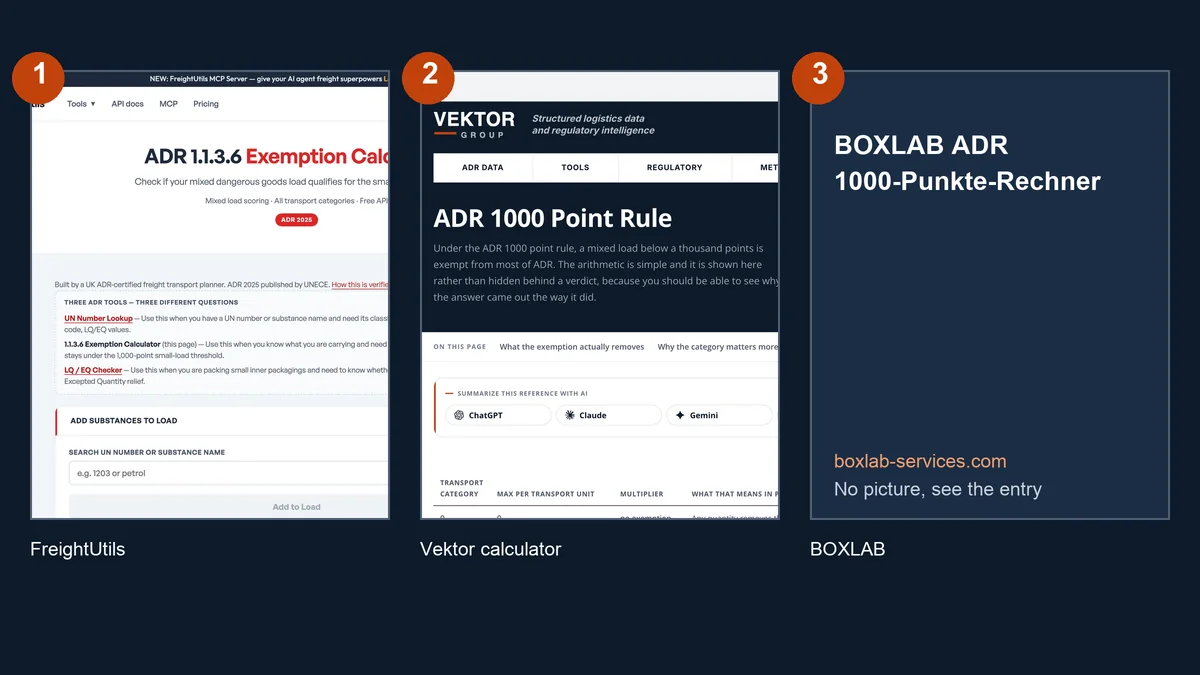
The order follows how correctly and how transparently each tool handled the three loads and the rule's special cases. No entry paid to be listed.
Contents
Key takeaways
The factors. Category 1 counts at 50, category 2 at 3, category 3 at 1; category 4 is not counted and category 0 has no exemption. (ADR 2025, 1.1.3.6.4)
Five of seven were right. Five calculators returned what the rule gives on all three test loads. (Vektor test, 7 Oct 2026)
A factor of 3.003. Special Cargo applies 1000/333 for category 2, so 300 litres scores 901 and a 1050 load scores 1051. (Vektor test, 7 Oct 2026)
A calculator that never adds up. NextSDS scores one substance per run, so a load over 1000 appears as two results under it. (Vektor test, 7 Oct 2026)
Gases by capacity. Compressed gases count by the water capacity of the receptacle, not by net mass. (ADR 2025, 1.1.3.6.3)
Note a goes in 2027. Factor 20 for nine UN numbers is deleted, with a transition to 31 December 2030. (ECE/TRANS/WP.15/274, 1.6.1.61)
Where to look first
The calculators split two ways: some look a UN number up and find the transport category for you, others ask for the category. A lookup is faster; entering the category yourself means reading Table A column 15, which is where most errors start.
| Your question | Where to look |
|---|---|
| A mixed load, by UN number, with the working shown | FreightUtils (entry 1) |
| You know the categories and want every step | Our calculator (entry 2) |
| A UN number lookup in German | BOXLAB (entry 3) |
| Ammonia, chlorine or a note a explosive on board | FreightUtils or ours, which apply factor 20; read the ADR 2027 section below |
| Gas cylinders on the load | FreightUtils, which counts compressed gases by water capacity |
| The calculation inside your own software | FreightUtils' API, with its request limits |
How we checked
On 7 October 2026 we ran every calculator on the same three loads and recorded what it returned. We took the rule from ADR 2025, subsections 1.1.3.6.3 and 1.1.3.6.4 (ECE/TRANS/352, volume I, pages 10 and 11), and a result counts as right when it matches that arithmetic.
We did not test every UN number in each tool's data, only our three loads and the factors each tool states. We left out Haufe's calculator, which needs a paid subscription, WEKA's page, which is an article and not a calculator, and the ADR Tunnels and Services app, whose store listing no longer exists.
| Load | What is on the vehicle | Transport categories | What the rule gives |
|---|---|---|---|
| A | UN 1203 petrol, 300 litres, and UN 1830 sulphuric acid, 50 litres | 2 and 2 | (300 + 50) × 3 = 1050, no exemption |
| B | UN 1263 paint, 600 litres, and UN 1791 hypochlorite solution, 300 litres | 3 and 3 | 600 + 300 = 900, exemption |
| C | UN 1092 acrolein, stabilized, 10 litres | 1 | 10 × 50 = 500, exemption |
How the calculators did
| Calculator | Input | Load A | Load B | Load C | Working shown | Note a | Gases by capacity |
|---|---|---|---|---|---|---|---|
| FreightUtils | UN number | 1050, not exempt | 900, exempt | 500, exempt | Per line | Yes | Yes |
| Vektor calculator | Category | 1050, over | 900, under | 500, under | Per line | Yes | No guidance |
| BOXLAB | UN number | 1050, over | 900, under | 500, under | Per line | Not tested | No |
| Rechner-Portal ADR-Check | Category | 1050, no exemption | 900, exemption | 500, exemption | Per position | No | No, net mass for all gases |
| MARTIN Spedition | Category | 1050, over | 900, under | 500, under | Total only | No | No |
| Special Cargo | Table row | 1051, over | 900, no warning | 500 | Per row | Not tested | Yes |
| NextSDS | UN number | No load total, 900 and 150 | Not reached | 500 | No | Its table states it wrongly | No |
1.FreightUtils' exemption calculator, for a mixed load by UN number
FreightUtils, a UK site of freight tools, looks up each UN number, takes the transport category from Table A and shows the sum line by line: 300 × 3 = 900 + 50 × 3 = 150 for our first load. It applies the factor 20 of note a and counts compressed gases by the water capacity of the receptacle, as 1.1.3.6.3 requires.
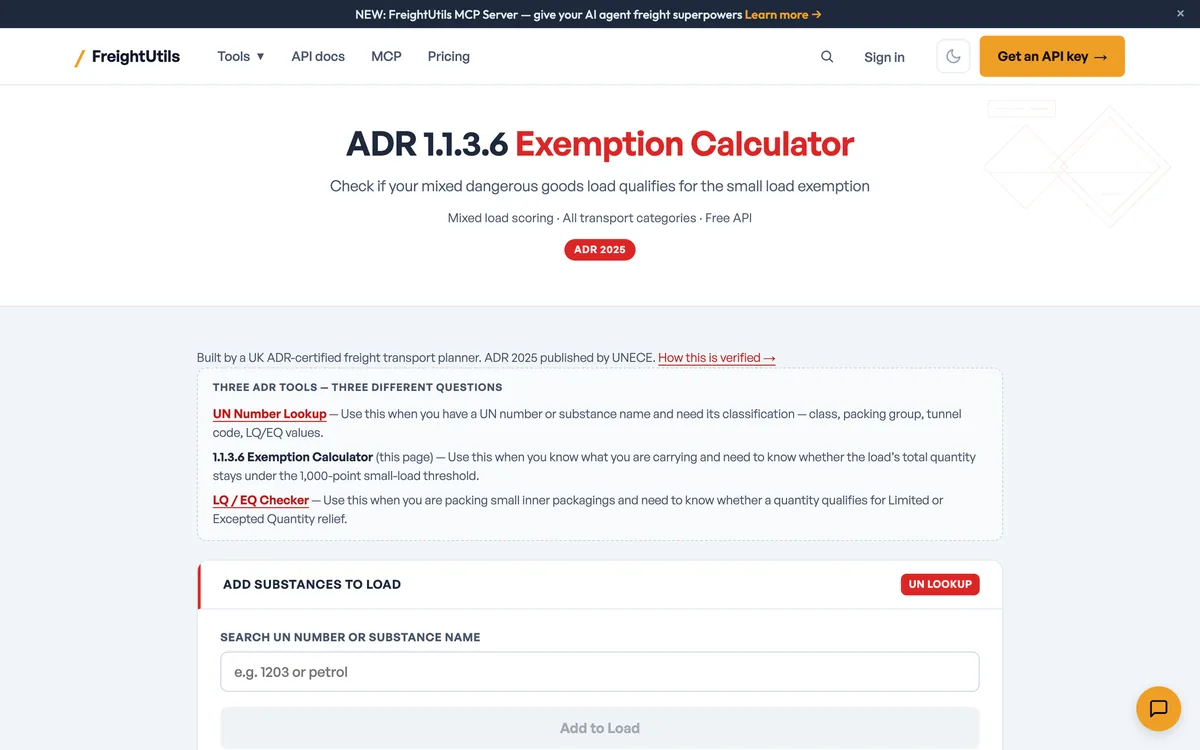
Our loads: 1050 and not exempt, 900 exempt, 500 exempt, each as the rule gives it.
Read on 7 October 2026: freightutils.com
2.Vektor's 1000 point calculator, for seeing the arithmetic by category
Ours takes a transport category and a quantity per line and shows category, quantity, factor and points for each, with the total against 1000. It includes category 0, where no exemption exists, and the factor 20 of note a for the nine UN numbers it covers.
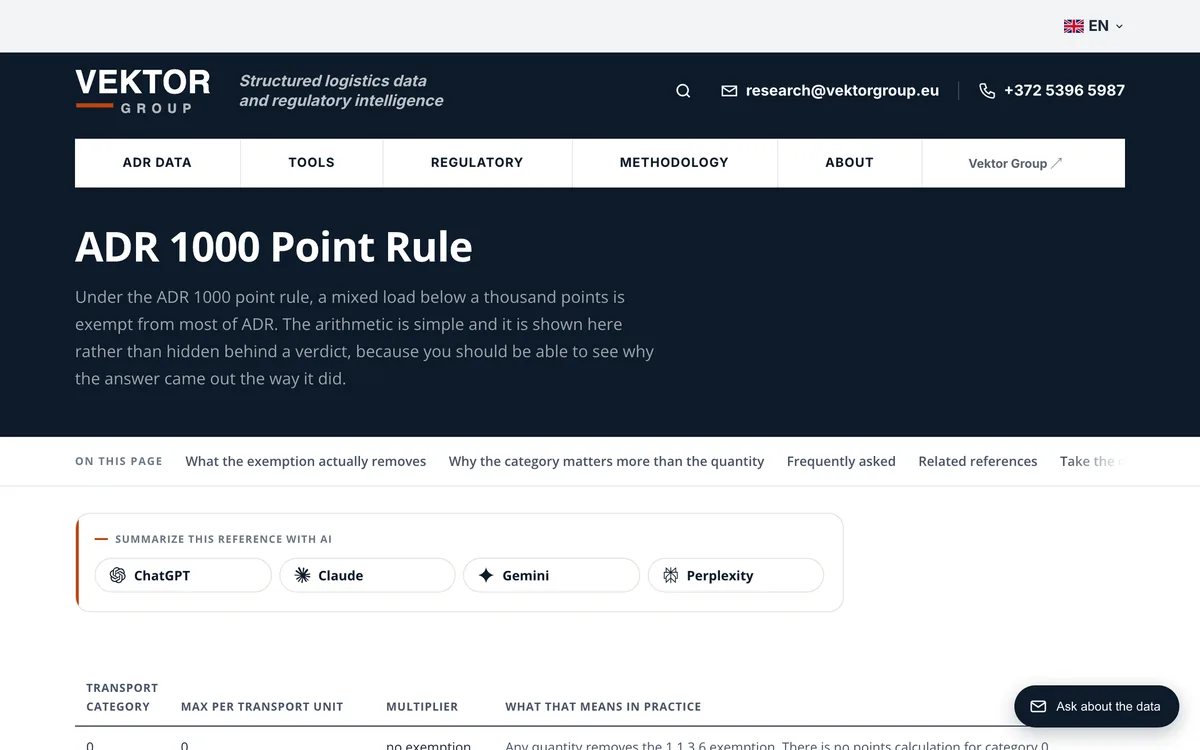
Our loads: 1050 over the threshold, 900 and 500 under, each as the rule gives it. We place it second, behind a calculator that also looks the UN number up, because it handles category 0 and note a explicitly and shows every step.
Read on 7 October 2026: vektorgroup.eu
3.BOXLAB's 1000 point calculator, for a UN number lookup in German
BOXLAB Services, a dangerous goods packaging company in Ludwigshafen, offers a calculator that looks up a UN number and lets you pick the packing group variant. Each line lists packing group, transport category, quantity, class, limited quantity, factor and points.
No picture: the page stays greyed out behind a consent box until it is answered, and we do not answer consent boxes for a picture.
Our loads: 1050 over, 900 and 500 under, each as the rule gives it, with the PG III variants chosen for the second load.
Read on 7 October 2026: boxlab-services.com
4.Rechner-Portal's ADR-Check, for a quick check of up to three lines
A German calculator portal's check takes up to three positions by transport category. It reports the points per position, whether the exemption applies and the capacity left, 100 points on our second load.
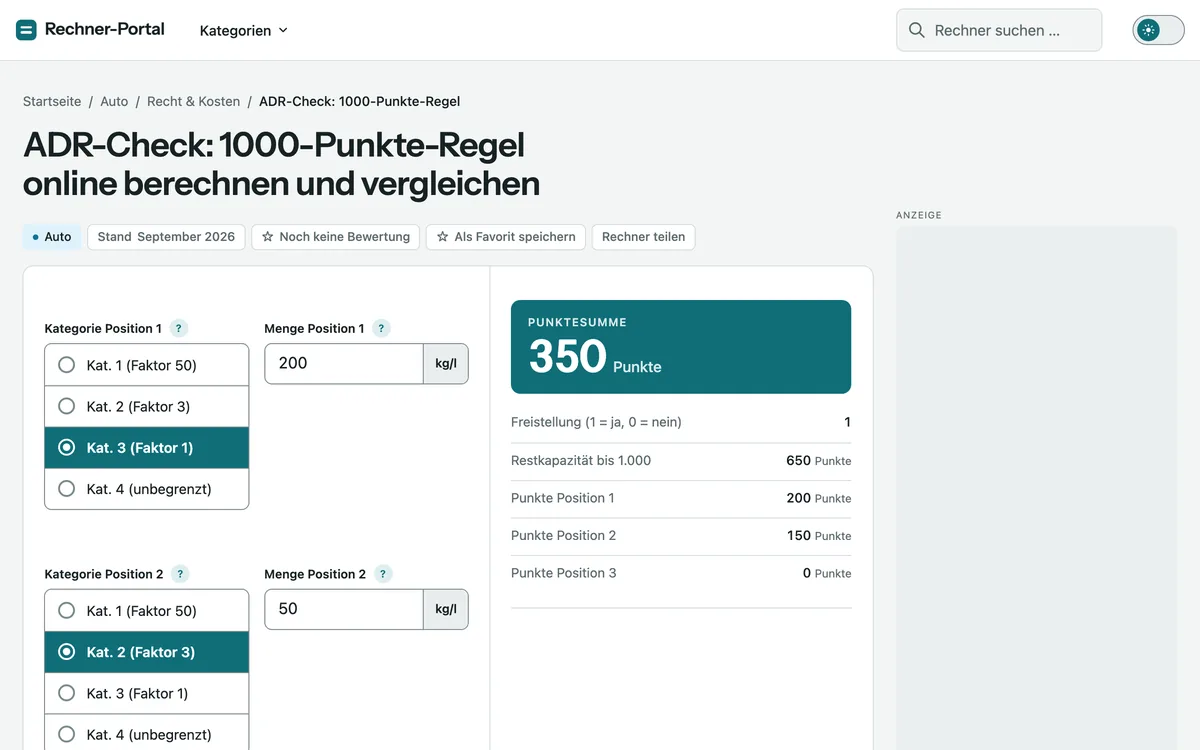
Our loads: 1050 and no exemption, 900 with the exemption, 500 with the exemption, each as the rule gives it.
Read on 7 October 2026: rechner-portal.de
5.MARTIN Spedition's calculator, for a total and a verdict
A freight forwarder's calculator where you enter class, transport category and quantity for each line and get a total with a verdict. It offers category 0 and categories 1 to 4 with the right factors.
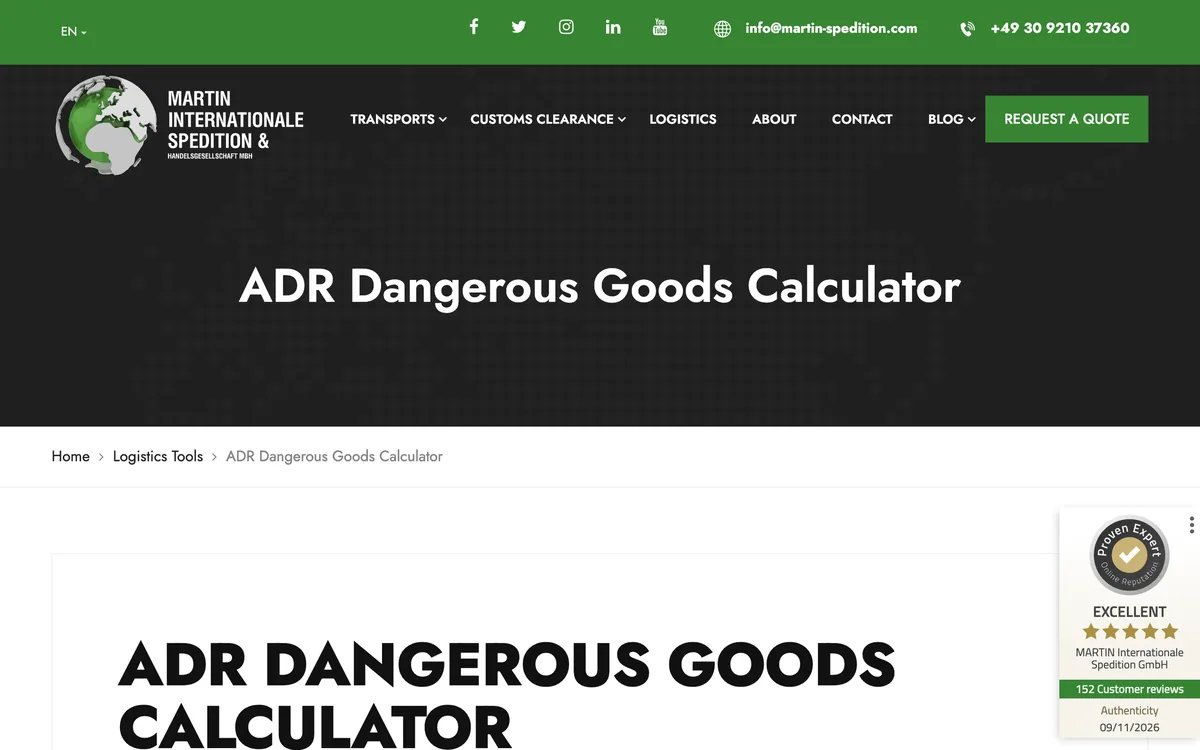
Our loads: 1050 over 1000 points, 900 and 500 under, each as the rule gives it.
Read on 7 October 2026: martin-spedition.com
6.Special Cargo's ADR points table, for working from the rows of the table
A Dutch carrier's tool lays out the 1.1.3.6.3 table with one input per row and calculates on the server. It quotes the counting basis, including water capacity for compressed gases.
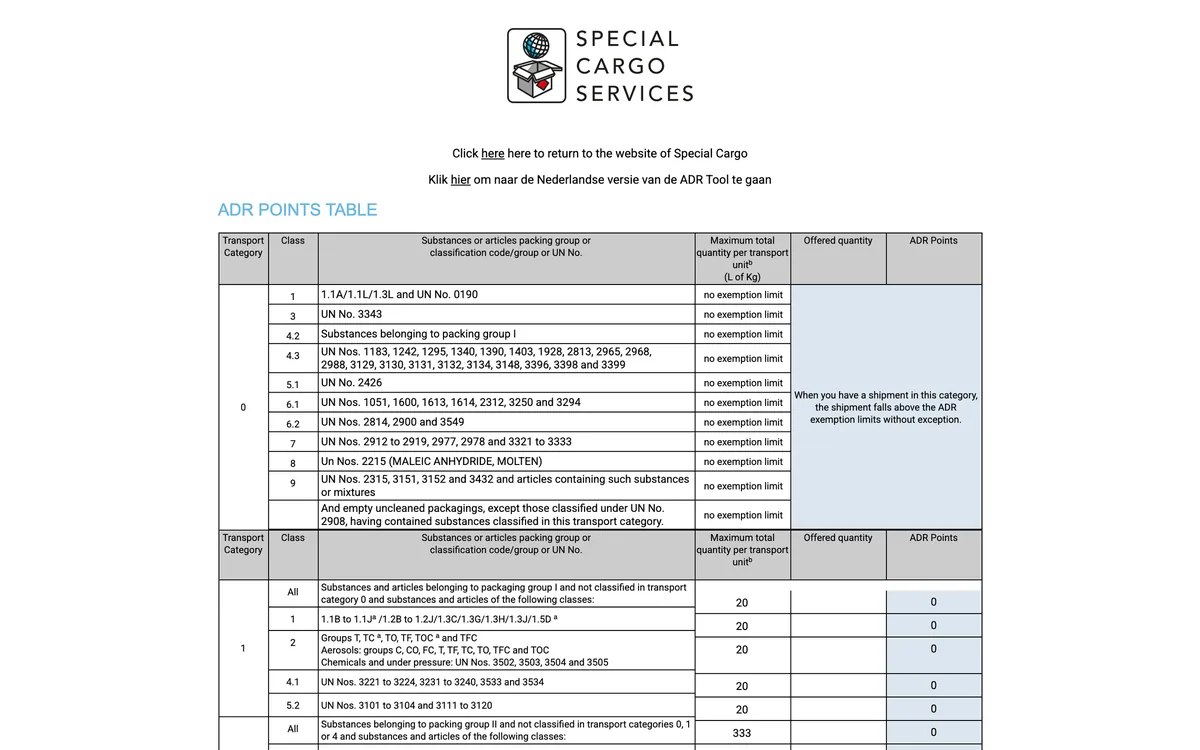
Our loads: 1051 and over the limit for the first, where the rule gives 1050, then 900 with no warning and 500. The difference is small, and it decides a load that sits on the threshold.
Read on 7 October 2026: services.specialcargo.com
7.NextSDS's ADR points calculator, for one substance at a time
A safety data sheet software company's free calculator looks up a UN number and scores one substance per run. The factors it applies are right: 50, 3 and 1 for categories 1, 2 and 3.
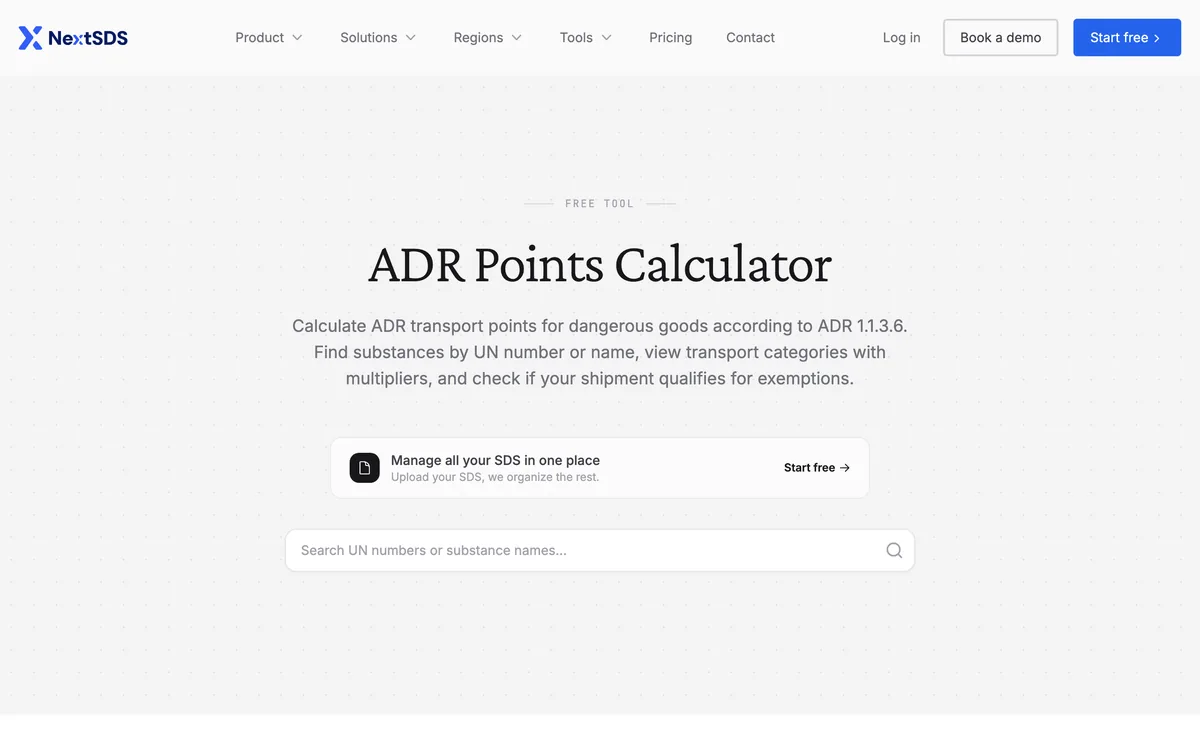
Our loads: 900 and 150 in separate runs for the first, so its breach of 1000 never appears; for the second, UN 1791 packing group III could not be reached; 500 for the third.
Read on 7 October 2026: nextsds.com
What changes with ADR 2027
ADR 2027 deletes table note a in 1.1.3.6.3, the 50 kg limit with factor 20 for UN 0081, 0082, 0084, 0241, 0331, 0332, 0482, 1005 and 1017, and the matching factor in 1.1.3.6.4. From 1 January 2027 those nine count like any other transport category 1 entry, at 20 with factor 50, and the new 1.6.1.61 lets the old note be applied until 31 December 2030.
It also adds UN 3563 and 3564 to transport category 2 for class 9. On 7 October 2026 every calculator here still worked to ADR 2025; ours explains the change on the page.
What a calculator will not tell you
The rule covers packages carried in one transport unit; a tank is outside it. Goods already exempt under other parts of 1.1.3, such as limited quantities, are left out of the count by 1.1.3.6.5.
Staying under 1000 points removes the vehicle marking, much of part 8 and the ADR driver certificate, not the transport document, and the transport category comes from Table A column 15 for each UN number. The official text governs over every tool here, ours included.
How to choose
| Your situation | Use | Check |
|---|---|---|
| You have UN numbers and need the answer now | Entry 1 or 3 | That the transport category shown is the one for your packing group |
| You are teaching or auditing the rule | Entry 2 | Each line against Table A column 15 |
| Your load sits near 1000 points | Entry 1 or 2 | Do not rely on entry 6, whose category 2 factor is 3.003 |
| You carry gas cylinders | Entry 1 | Water capacity, not net mass, for compressed gases |
| You plan for 2027 | Any, then subtract by hand | Note a's nine UN numbers at factor 50, or the 2030 transition |
Common questions
What are the factors in the 1000 point rule?
Transport category 1 counts at 50, category 2 at 3 and category 3 at 1; category 4 is not counted and category 0 has no exemption. Until ADR 2027, note a gives nine UN numbers in category 1 a factor of 20 instead (1.1.3.6.4).
How are gases counted?
Liquefied, refrigerated liquefied and dissolved gases by net mass in kilograms; compressed and adsorbed gases and chemicals under pressure by the water capacity of the receptacle in litres (1.1.3.6.3).
Does ADR 2027 change the rule?
Yes, for nine UN numbers: note a and its factor 20 are deleted, with a transition to 31 December 2030 under the new 1.6.1.61, and UN 3563 and 3564 join category 2 for class 9.
Why is Vektor's calculator second?
Because the first also looks the UN number up and counts gases by water capacity, which ours does not. Ours is second because it got every load right, shows every step and handles category 0 and note a.
Summary
For a mixed load by UN number, use FreightUtils; to see the arithmetic or teach it, use ours; in German, BOXLAB or Rechner-Portal. Do not rely on a tool that scores one substance at a time or rounds the category 2 factor. Check the category in Table A, and from 2027 check note a by hand.
Sources
Download the comparison
The results as a file you can reuse under CC BY 4.0, crediting Vektor Group. The calculators belong to their publishers; the test and the comparison are ours.
Test results, CSVSeven calculators, the three loads, what each returned, the factors it applies and its limitsMore lists and references
About Vektor Research
Vektor Research is the reference side of Vektor Group, a road freight broker in Tallinn that arranges ADR and chemical transport. The research pages are free to read and to reuse under CC BY 4.0, and they carry no offer.
Rene Siller is responsible for the content; how the pages are built is set out in the methodology, and errors are corrected in the open. Editorial questions and error reports go to info@vektorgroup.eu.
No entry paid to be listed and no link carries an affiliate code.
Cite this list
Vektor Research. ADR 1000 Point Calculators: 7 Free Tools Run on the Same Three Loads. Vektor Group, 7 October 2026. https://vektorgroup.eu/adr-1000-point-calculators