
Research library / ADR & Dangerous Goods
Research list
Official ADR Sources and Where to Find Them: 7 Routes Compared (2026)
Official ADR sources are spread over an agreement, two annexes, an EU directive and a national law in each country, and no single site holds all of it. This list maps where each official layer is published and what it is for, starting with an index that points into them.
Each entry says what kind of source it is, who it binds and where it stops.
Updated October 20267 compared
Contents
Key takeaways
The agreement and the rules sit apart. The UN Treaty Collection holds the 1957 agreement and its 55 parties; UNECE publishes Annexes A and B, the working rules. (UN Treaty Collection; UNECE)
EU law makes ADR domestic. Directive 2008/68/EC covers transport within or between Member States and applies ADR Annexes A and B through its Annex I. (Directive 2008/68/EC)
National publication decides what binds. Germany's transport ministry states that only texts in the Bundesgesetzblatt or Verkehrsblatt are binding. (BMV, Gefahrgut Recht und Vorschriften Straße)
Databases and indexes do not govern. BAM excludes liability for its data, and our library says the official ADR text and national law govern. (BAM legal notice; Vektor research library)
Where to look first
Each question below has one right place to start. Entry 1 is our index and not an official source; entries 2 to 6 are official texts or official guidance; entry 7 is a public technical database.
| Your question | Where to look |
|---|---|
| Which official text is this fact based on? | Our research library (entry 1) names it; then open that text below |
| What exactly does ADR say? | UNECE's ADR 2025 files (entry 2) |
| Who is party to ADR, and was an amendment accepted? | The UN Treaty Collection (entry 3) |
| Does ADR apply to a journey inside one EU country? | Directive 2008/68/EC (entry 4) |
| Which German text is binding? | The Federal Ministry for Transport page (entry 5) |
| Which UK notices or derogations apply? | The GOV.UK collection (entry 6) |
| What are this substance's transport data? | BAM DGG-Info (entry 7), then the provision in entry 2 |
How the sources compare
| Source | Source type | Jurisdiction | Road relevance | How editions are tracked | Access | When to use |
|---|---|---|---|---|---|---|
| Vektor research library | Unofficial index, not law | None; points to official texts | ADR road topics we have built | Version and last verified date per page | Free, CC BY 4.0 | To find which official provision to open |
| UNECE ADR 2025 files | Official edition of Annexes A and B | The 55 parties | The road rules themselves | ADR 2025 volumes and corrigenda | Free PDF, all rights reserved | To quote a provision |
| UN Treaty Collection | Depositary record, official | The 55 parties | Agreement articles and status | Depositary notifications | Free | To check parties and amendment acceptance |
| Directive 2008/68/EC | EU law, official | EU Member States | Applies ADR within and between Member States | Annex I adapted to ADR amendments | Free | To show ADR applies domestically in the EU |
| BMV, Germany | National implementation, official | Germany | Promulgates each ADR edition | ADR amending ordinances in the Bundesgesetzblatt | Free, German | For the binding German text |
| GOV.UK collection | National guidance and notices, official | United Kingdom | Notices, derogations, agreements | Collection updated 23 Dec 2024 | Free, OGL v3.0 | For UK notices and contacts |
| BAM DGG-Info | Technical database, not law | Published in Germany, data across modes | Substance data drawn from the rules | Version notes on BAM's site | Free, dl-de/by-2-0 | For a substance lookup before the rule |
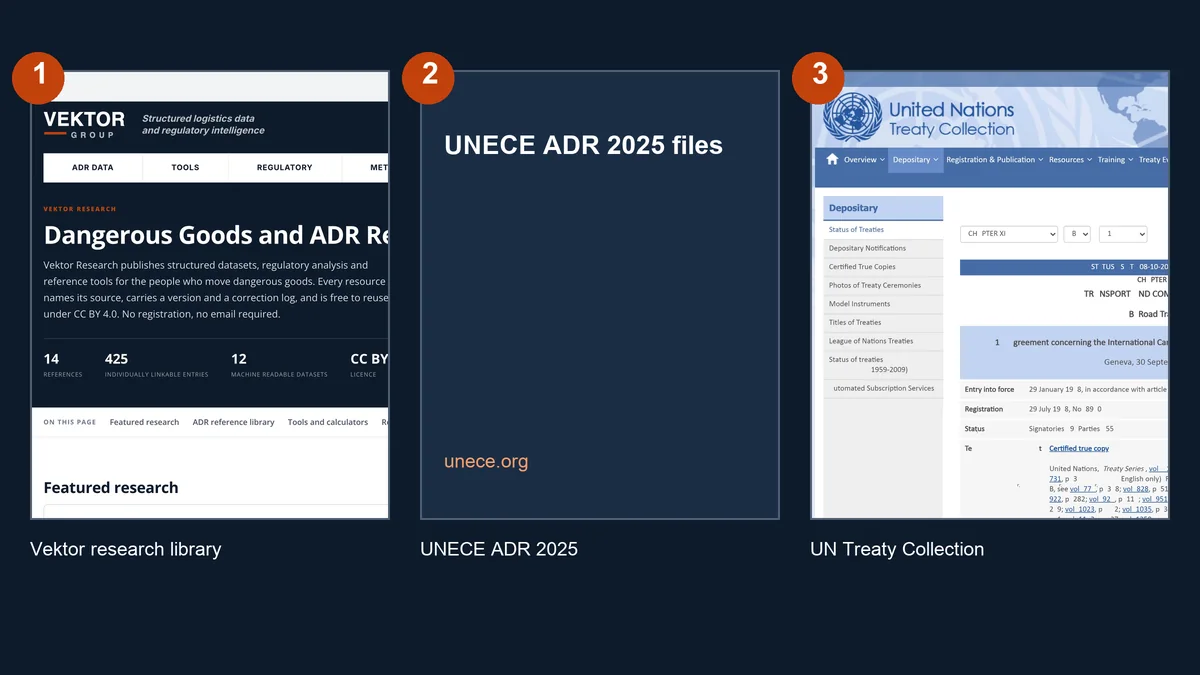
1.Vektor research library, for finding the official text behind a fact (not an official source)
Our research library is not an official source. It is an index of 14 working references on ADR road transport, and every page names the ADR provision or UN document it rests on, so you can go from a fact to the official text and cite that.
Our methodology page lists the official documents we work from: for ADR 2027, ECE/TRANS/WP.15/274 with its corrigendum and addendum and the depositary notification C.N.252.2026, with BAM's ADR 2025 dataset as the baseline.
Source: vektorgroup.eu
2.UNECE's ADR 2025 files, for the wording of Annexes A and B
UNECE publishes ADR 2025, the edition of Annexes A and B that took effect internationally on 1 January 2025, as two PDF volumes with three corrigenda. Table A, the dangerous goods list, is in Part 3 of volume 1. GOV.UK links here as the place the road rules are set out.
UNECE also keeps the register of multilateral agreements concluded under ADR 1.5.1, M178 to M372; each binds only its signatories.
Source: unece.org
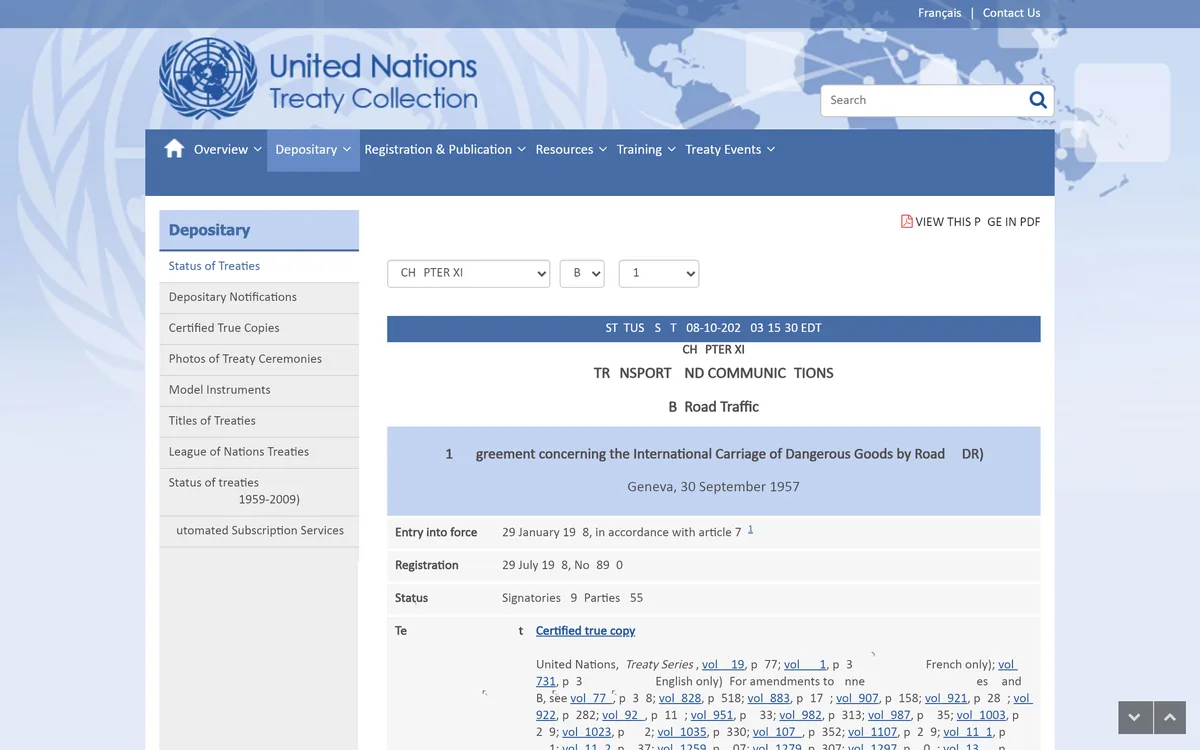
3.UN Treaty Collection, for the agreement, its parties and its status
The Treaty Collection holds the depositary record for the agreement itself: done at Geneva on 30 September 1957, in force since 29 January 1968, with a certified true copy and the list of parties. Its notes record how amendments to the annexes were accepted.
Source: treaties.un.org
4.Directive 2008/68/EC, for how ADR applies inside the EU
The directive applies to road, rail and inland waterway transport of dangerous goods within or between Member States. Its Annex I applies ADR Annexes A and B to road transport, so ADR governs a domestic EU journey as well as a cross border one.
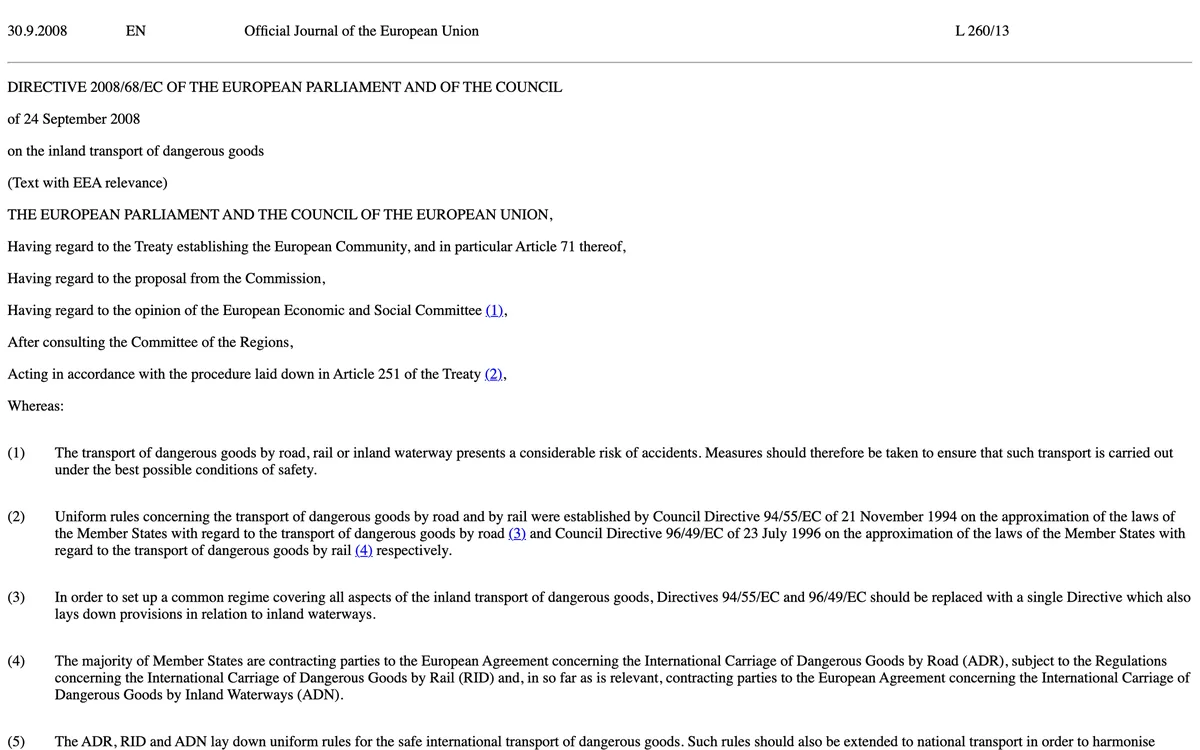
Articles 5 and 6 let a Member State apply stricter rules to national transport or request derogations, for example for small quantities.
Source: publications.europa.eu
5.Germany's Federal Ministry for Transport, for one country's binding texts
The ministry's page lists the instruments that bring ADR into German law, from the act approving the 2019 protocol to the 30th ADR amending ordinance of 19 February 2025, which promulgated ADR 2025.
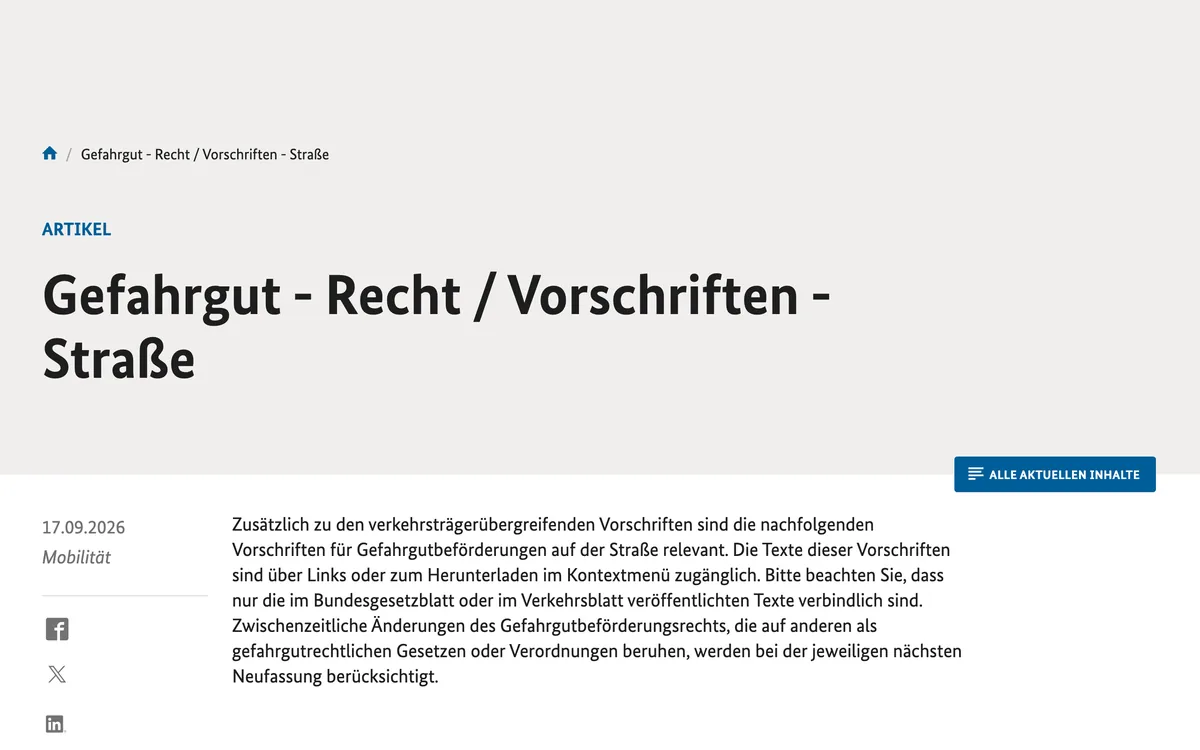
Germany announces its multilateral agreements in the ADR exceptions ordinance. The page also links an advance German translation of the 2027 changes, compared in our ADR 2027 sources list.
Source: bmv.de
6.GOV.UK's dangerous goods collection, for UK notices, derogations and contacts
The Department for Transport and DVSA collect their guidance here: statutory guidance on derogations, authorisation and exception notices, multilateral agreements and incident reporting.
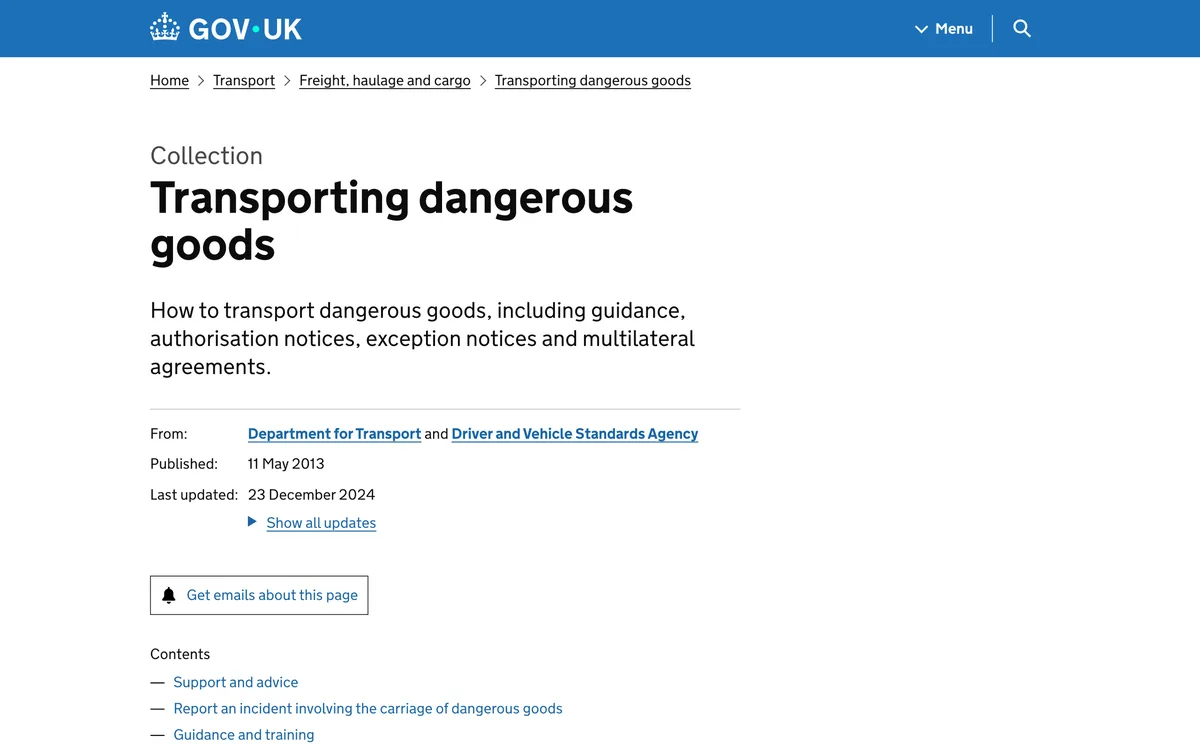
For the text itself, the GOV.UK road rules page links UNECE's 2025 files. DVSA's DGSA exam page is training material, not an official source.
Source: gov.uk
7.BAM's Dangerous Goods Database, for a substance's data before the rule
BAM, Germany's Federal Institute for Materials Research and Testing, describes its database as processed and condensed information from the dangerous goods regulations. Since 23 July 2025 the DGG-Info search, in German and English, and the data service have been free.
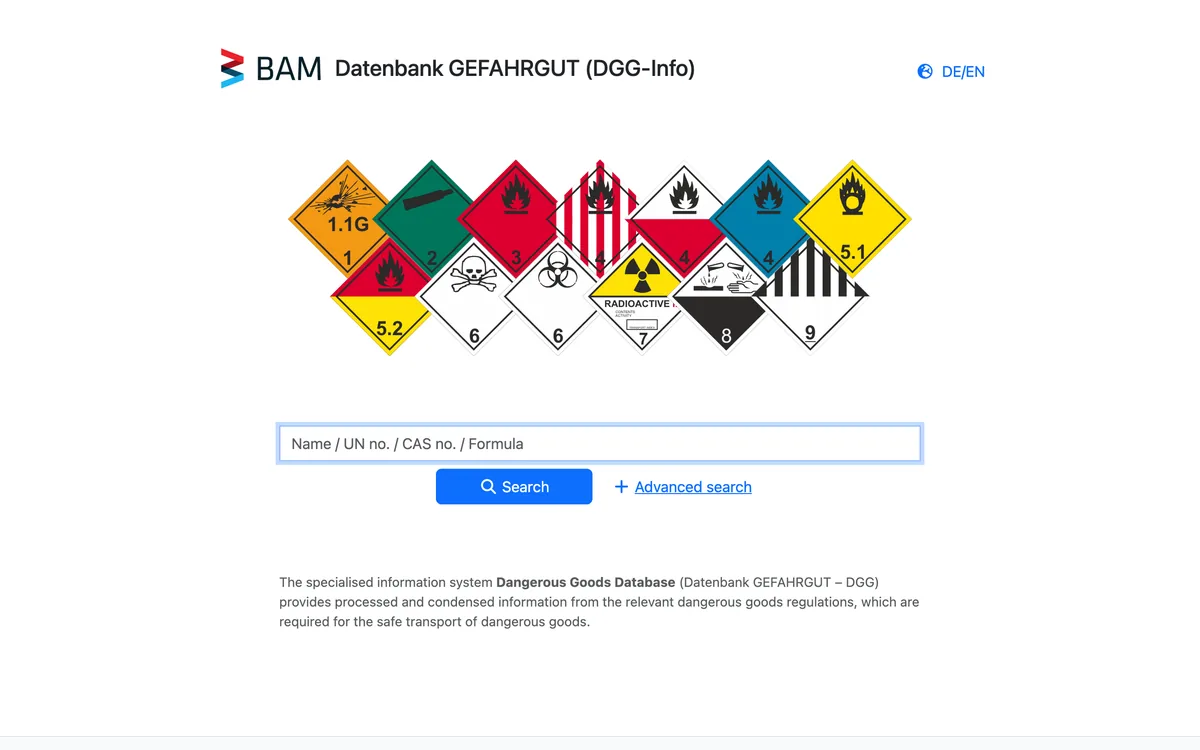
Source: dgg.bam.de
Source hierarchy and jurisdiction
Read the layers in order. The agreement, held by the UN Treaty Collection, binds its parties to each other.
Annexes A and B, published by UNECE, carry the rules a consignor or carrier actually follows. A provision quoted from anywhere else should be checked against that text.
Inside the EU, Directive 2008/68/EC makes the annexes apply to transport within a Member State as well as between them. Each country then publishes its own binding version, as Germany does in the Bundesgesetzblatt, and may add derogations the directive allows or multilateral agreements it signs.
Guidance, databases and indexes sit below all of this. Where one disagrees with the official text, ours included, the official text governs.
Sources are not shipment advice
This is a guide to sources, not advice on a shipment. Classification stays with the consignor and its dangerous goods safety adviser, and a citation should point to the official text, not to this page or a database.
Citation worksheet for an ADR source
Fill one row per source before you cite it, so a reader can find exactly what you read.
| Field | What to write | Your answer |
|---|---|---|
| Institution | Who publishes it, for example UNECE or BMV | |
| Source type | Agreement, annex text, EU law, national law, guidance, database or index | |
| Document identifier | Symbol, CELEX number or gazette reference, for example BGBl. 2025 II Nr. 57 | |
| Edition | The ADR edition or version, for example ADR 2025 | |
| Section | The paragraph or table you rely on, for example 1.1.3.6 | |
| Jurisdiction | Where it binds: the parties, the EU, or one country | |
| Binding status | Binding text, advance translation, guidance or unofficial | |
| Retrieval date | The day you consulted it, and the date shown on the page |
Common questions
Where is the official ADR text?
Annexes A and B, the rules, are published by UNECE as the ADR 2025 volumes. The agreement itself and its list of parties are on the UN Treaty Collection.
Is Vektor's research library an official source?
No. It is an index of working references, each naming the provision it rests on. Use it to find the official text, then cite that text.
Does ADR apply to a domestic journey in the EU?
Yes. Directive 2008/68/EC covers transport within or between Member States and applies ADR Annexes A and B to road transport, subject to the derogations it allows.
Which edition applies now?
ADR 2025, which took effect internationally on 1 January 2025. For the 2027 amendments and their status, see our ADR 2027 sources list.
How should I cite an ADR source?
Give the institution, the document identifier, the edition, the section and the date you read it. The worksheet above has a field for each.
Summary
Rules: UNECE's ADR 2025 files. Parties and status: the UN Treaty Collection.
EU: Directive 2008/68/EC. One country: its own gazette. Databases and our index help you find a provision and never replace it.
Sources
Downloads
More lists and references
About Vektor Research
Vektor Research is the reference side of Vektor Group, a road freight broker in Tallinn that arranges ADR and chemical transport. The research pages are free to read and to reuse under CC BY 4.0, and they carry no offer.
Rene Siller is responsible for the content; how the pages are built is set out in the methodology, and errors are corrected in the open. Editorial questions and error reports go to info@vektorgroup.eu.
No entry paid to be listed and no link carries an affiliate code.
Cite this list
Vektor Research. Official ADR Sources and Where to Find Them: 7 Routes Compared (2026). Vektor Group, 8 October 2026. https://vektorgroup.eu/resources/dangerous-goods/official-adr-sources