
Research library / ADR & Dangerous Goods
Research list
Cargo Securing Guidance: 7 Free Resources for Road and CTU Loads (2026)
Free cargo securing guidance for road freight sits in a few documents of very different kinds: EU law on roadside inspection, non-binding codes, informative material, an industry summary, and a carrier page where securing meets an ADR check.
Each entry gives the issuer, edition, scope and legal status. The securing methods themselves are in the documents, so open them for that.
Updated October 20267 compared
Contents
Key takeaways
Law and guidance differ Directive 2014/47/EU governs roadside checks of securing; the 2014 EU guidelines state they are not binding as a legal act. (Directive 2014/47/EU; EU guidelines 2014)
Road and CTU have separate codes The EU guidelines cover vehicles over 3.5 tonnes and point intermodal work to the CTU Code. (EU guidelines 2014, section 1.1)
Two CTU circulars, not one MSC.1/Circ.1498 states it is not part of the CTU Code, MSC.1/Circ.1497. (IMO, MSC.1/Circ.1498)
DVSA is Great Britain only GOV.UK states the guide applies to England, Scotland and Wales; updated 24 September 2026. (DVSA, securing loads guide on GOV.UK)
Where to look first
Start from the transport unit. A vehicle loaded for the road points to the EU guidelines, the directive and, in Great Britain, DVSA. A container or other cargo transport unit (CTU) points to the CTU Code family.
| Your question | Where to look |
|---|---|
| Where does securing sit in a carrier check for ADR work? | Our carrier compliance page (entry 1) |
| Where is practical EU guidance for road loads? | The 2014 EU guidelines (entry 2) |
| How is a roadside securing check classified? | Directive 2014/47/EU, Annex III (entry 3) |
| How should containers or swap bodies be packed? | The CTU Code (entry 4) |
| Where are the CTU background modules and quick lashing guide? | Informative material, MSC.1/Circ.1498 (entry 5) |
| Is there a short CTU Code briefing for a team? | The Cargo Integrity Group quick guide (entry 6) |
| What applies to vehicles in England, Scotland or Wales? | DVSA's guidance (entry 7) |
How the resources compare
| Document | Issuing body | Vehicle or CTU scope | Jurisdiction and status | Edition | Access and language | Training use |
|---|---|---|---|---|---|---|
| Vektor carrier compliance page | Vektor Group | Carriers on freight we place, ADR included | A brokerage's carrier expectations, not guidance | No date shown | Free; English, German, Dutch | Shows securing beside marking, routing, documents |
| EU cargo securing guidelines | European Commission expert group | Road vehicles, focus over 3.5 t | EU; not binding as a legal act | Final version 8 May 2014 | Free PDF, 96 pages | Names driver training as a use |
| Directive 2014/47/EU, Article 13 and Annex III | European Parliament and Council | Commercial vehicles at roadside inspection | EU directive | OJ L 127, 29 April 2014 | Free on EUR-Lex | Article 13(4): checkers to be trained |
| CTU Code, MSC.1/Circ.1497 | IMO, ILO, UNECE | CTUs by sea and land | Global; non-mandatory per IMO | 2014; circular of 16 Dec 2014 | Free PDF, 149 pages | Annex 10 on training programmes |
| Informative material, MSC.1/Circ.1498 | IMO Maritime Safety Committee | CTUs, modules IM1 to IM10 | Not part of the CTU Code | 16 Dec 2014 | Free PDF, 181 pages | IM5 quick lashing guide |
| CTU Code, a quick guide | Cargo Integrity Group | Freight containers | Industry guidance | Second edition, Sept 2022 | Free PDF, 7 languages, all rights reserved | Briefing plus packing checklist |
| DVSA securing loads guidance | DVSA | HGVs, trailers, vans, cars | GB only; not a legal document; compulsory only where it says must | Updated 24 Sep 2026 | Free web guide | For operators, drivers, consignors |
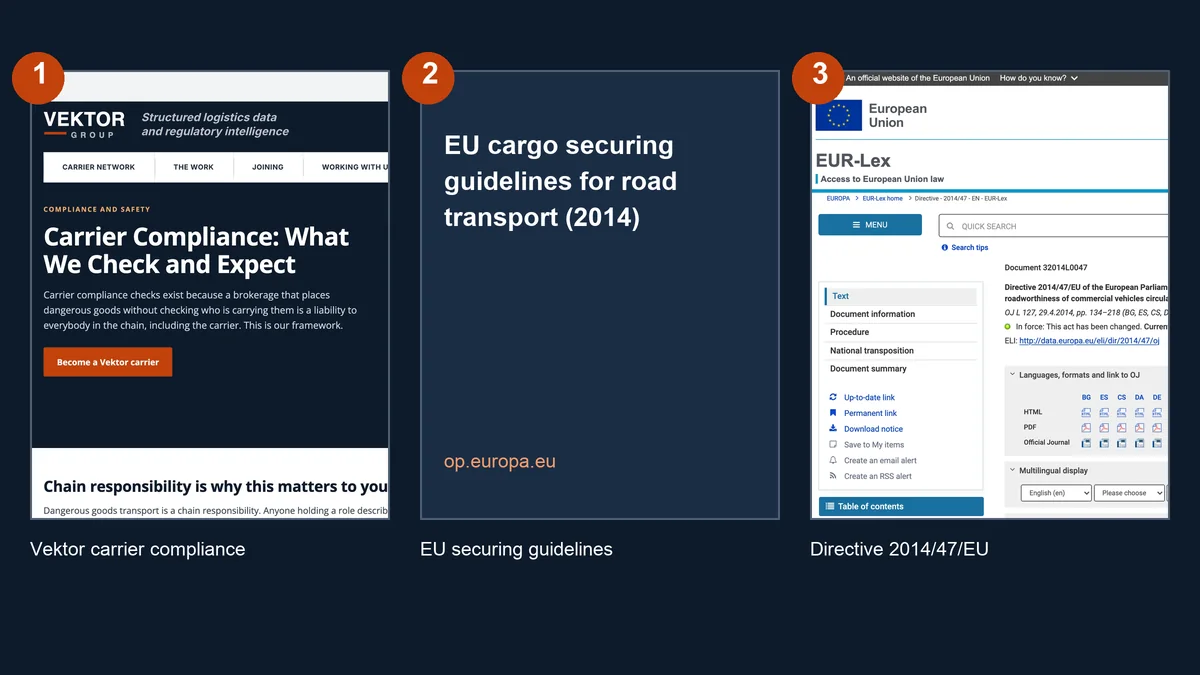
1.Vektor carrier compliance page, for where securing meets an ADR carrier check
We do not publish a cargo securing guide. This is our carrier compliance page: what we verify before activating a carrier, such as ADR driver certificates and a safety adviser appointed under ADR 1.8.3, and four things we expect on the road. Load securing is the first, beside marking, agreed routing and documents in the cab, and it is one sentence long.
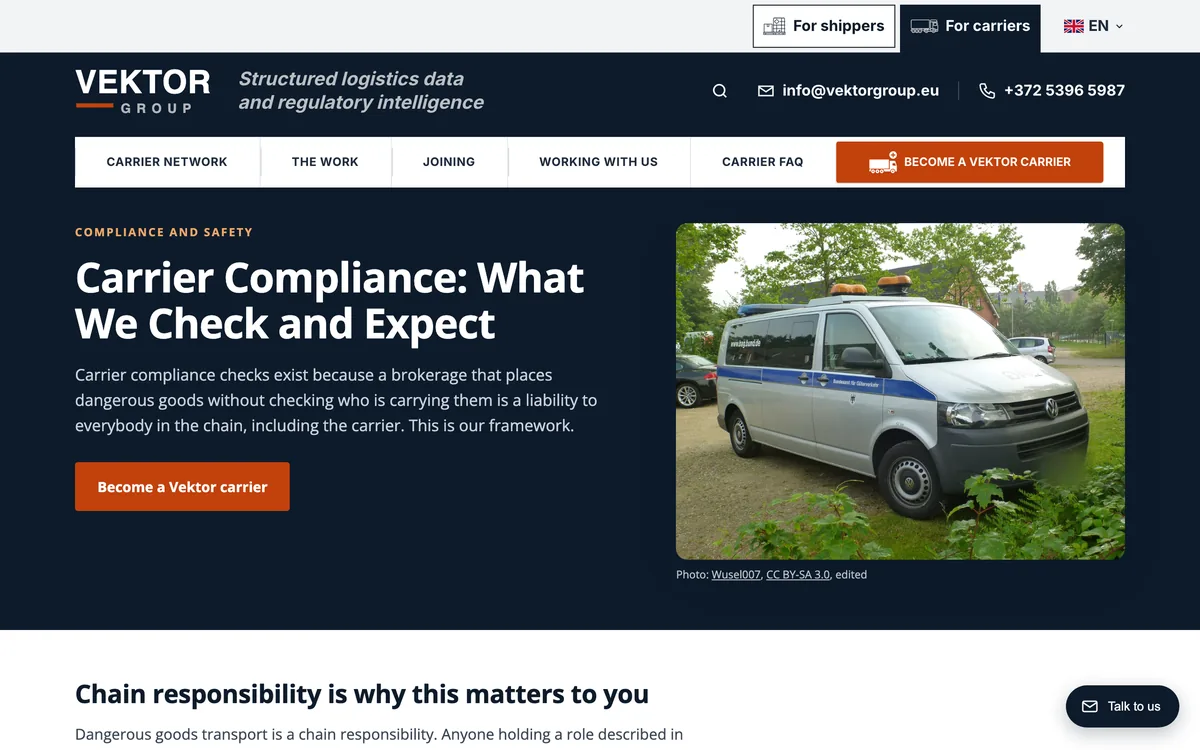
Its marking line links to our ADR marking checks.
Source: vektorgroup.eu
2.EU cargo securing guidelines, for practical road guidance
Practical guidance for everyone who loads, unloads and secures cargo on vehicles, prepared by a European Commission expert group with Member State and industry experts. It states it is based on EN 12195-1, focuses on vehicles over 3.5 tonnes and supports ADR and Directive 2014/47/EU. The European Commission's road safety page links it.
Source: op.europa.eu
3.Directive 2014/47/EU, for how securing is inspected at the roadside
EU law on technical roadside inspections of commercial vehicles. Article 13 allows a cargo securing inspection under Annex III, which sets out principles, lists applicable standards and defines minor, major and dangerous deficiencies.
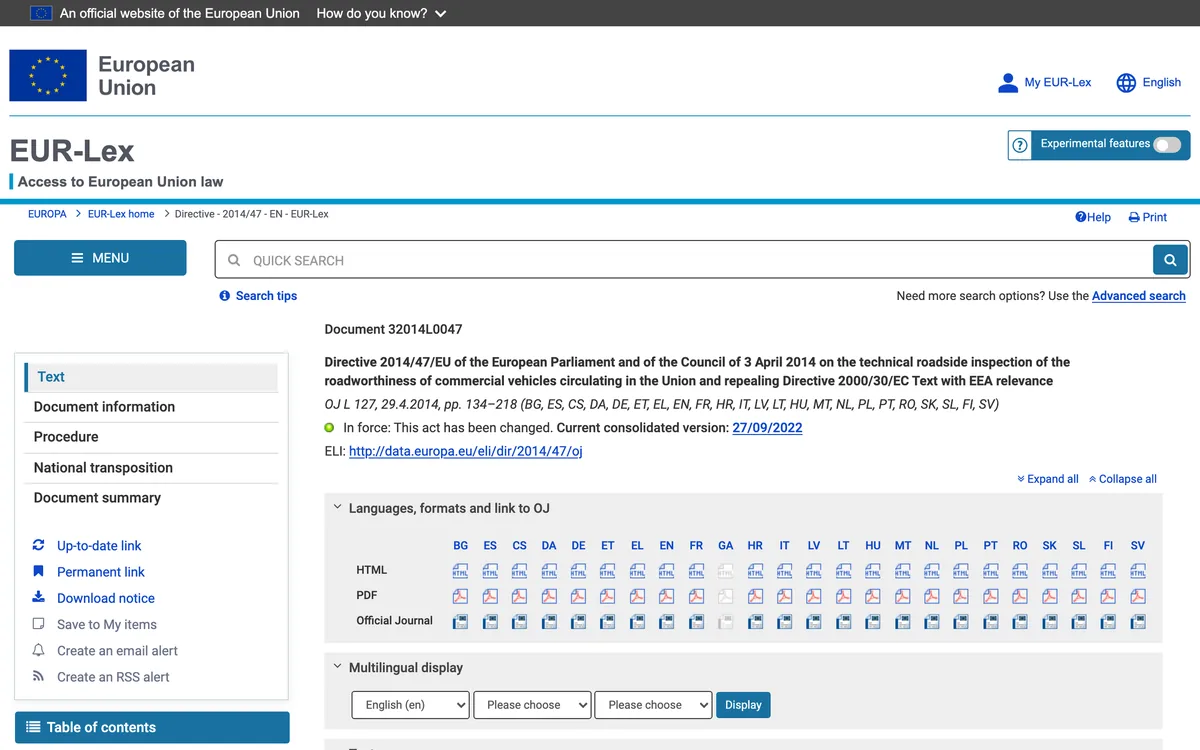
Article 13(2) applies without prejudice to rules such as ADR.
Source: eur-lex.europa.eu
4.The CTU Code, for packing and securing cargo in transport units
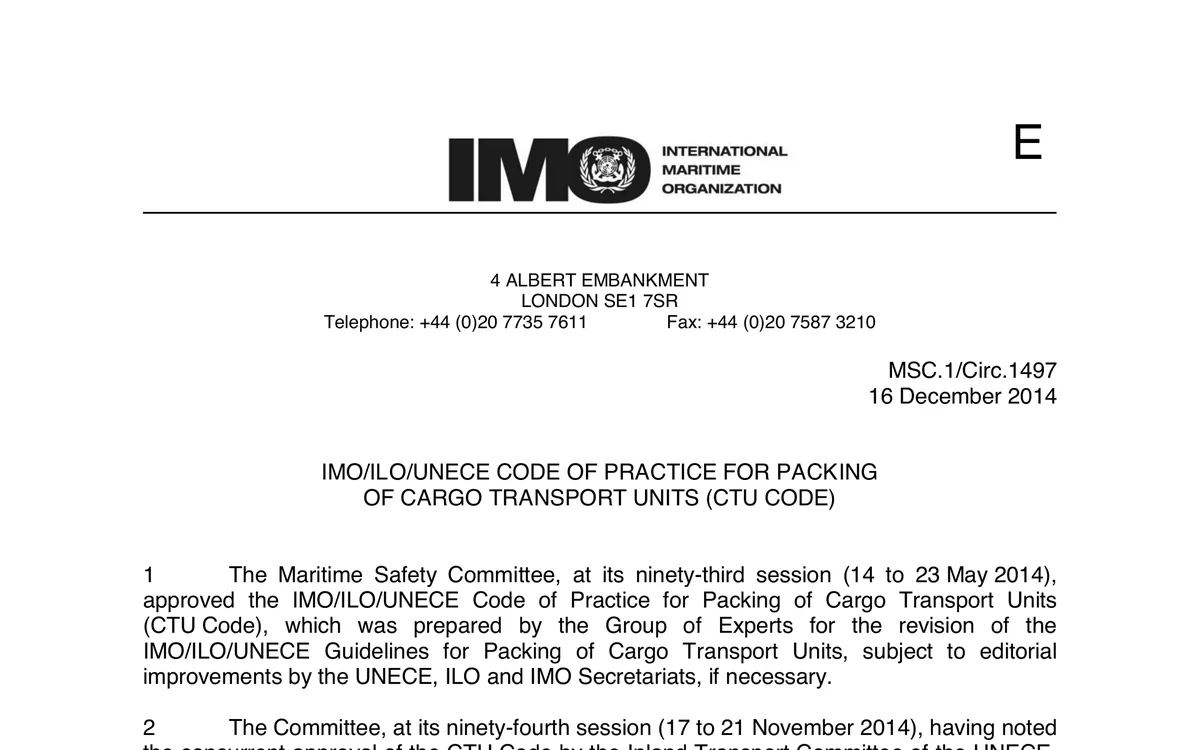
The Code of Practice for Packing of Cargo Transport Units, endorsed by IMO, ILO and UNECE in 2014. IMO's page calls it a non-mandatory global code for sea and land transport. Chapter 9 is its core, with Annex 7 on packing and securing.
Source: imo.org
5.The CTU informative material, for background and quick lashing guides
Ten modules the CTU Code refers to, IM1 to IM10, covering CTU types, intermodal load distribution, seals, gas testing and, in IM5, a quick lashing guide. The circular states it is not part of the Code.
Source: imo.org
6.The Cargo Integrity Group quick guide, for a short CTU Code briefing
An industry summary of the CTU Code from the Cargo Integrity Group, whose partners include ICHCA, TT Club, FIATA and the World Shipping Council. It says it is a route map into the Code and follows the packing process, with sections on securing and dangerous goods planning.
Source: ichca.com
7.DVSA's securing loads guidance, for vehicles in Great Britain
A seven part GOV.UK guide for operators, drivers and consignors, covering HGVs, trailers, vans and cars. It replaced the earlier safety of loads code of practice and load securing operator guidance.
Its about section says examiners use the categorisation of vehicle defects, not this guide, for enforcement. A December 2024 update added DGSA information and ADR marks on IBCs.
Source: gov.uk
Road guidance or CTU guidance
Use the road documents for a vehicle on the road, and the CTU documents when cargo is packed into a unit that may also travel by sea or rail. On an ADR load, the directive and the EU guidelines both refer to ADR, so start with ADR itself and your safety adviser.
What kind of document each one is
| Kind | Entries | How to cite it |
|---|---|---|
| EU law | 3 | By article and annex, from the Official Journal |
| Non-binding code or guidance from a public body | 2, 4, 7 | As guidance, with its status; quote any must in the document's own words |
| Informative material | 5 | Separately from the CTU Code, which it is not part of |
| Industry summary | 6 | As a route into entry 4, never in its place |
| Broker page | 1 | As one brokerage's carrier expectations |
How to cite guidance in training
Give issuer, full title, edition, date read and status. Cite the directive by article and annex and the CTU Code by circular and chapter.
Name EN 12195-1 with the edition the source cites but do not reproduce it, and leave figures to a qualified reviewer. The EU guidelines allow reproduction with acknowledgement; the quick guide reserves all rights.
Updates and corrections
The DVSA guide was last updated in September 2026, so check it for changes before each course. Corrections follow our methodology. For ADR sources, see free ADR resources.
Source selection checklist for a cargo securing course
One per course. It records sources, not securing methods, and makes no compliance judgement.
| Field | What to write | Your answer |
|---|---|---|
| Course and audience | Who is trained, for which work | |
| Transport unit | Road vehicle, CTU, or both | |
| Countries | Where trainees operate, for national guidance | |
| Law cited | Document, article, annex | |
| Guidance cited | Issuer, title, edition, stated status | |
| Summaries used | Title, issuer, document summarised | |
| Standards named | Number, edition cited, licence held | |
| Language version | Language and issuer of that version | |
| Date read | One per document | |
| Technical reviewer | Name and qualification | |
| Next recheck | Date and source most likely to change |
Common questions
Are the EU cargo securing guidelines binding?
They state they are not binding as a legal act. Directive 2014/47/EU is law and governs roadside securing checks.
Is the CTU Code mandatory?
IMO calls it non-mandatory, and the Code says it does not replace national or international regulations.
Which edition of EN 12195-1 applies?
The EU guidelines were written against the 2010 edition; Article 13(2) of the directive allows the latest version, so confirm the current edition before a course.
Does Vektor publish a cargo securing guide?
No. Entry 1 is our carrier compliance page, where securing is one carrier expectation. For guidance, use entries 2 to 7.
Summary
Road practice: the 2014 EU guidelines. Roadside classification: Directive 2014/47/EU.
Packed containers: the CTU Code and its informative material, with the quick guide as an introduction. Great Britain: DVSA. Our compliance page shows where securing sits in a carrier check; the documents govern.
Sources
Downloads
More lists and references
About Vektor Research
Vektor Research is the reference side of Vektor Group, a road freight broker in Tallinn that arranges ADR and chemical transport. The research pages are free to read and to reuse under CC BY 4.0, and they carry no offer.
Rene Siller is responsible for the content; how the pages are built is set out in the methodology, and errors are corrected in the open. Editorial questions and error reports go to info@vektorgroup.eu.
No entry paid to be listed and no link carries an affiliate code.
Cite this list
Vektor Research. Cargo Securing Guidance: 7 Free Resources for Road and CTU Loads (2026). Vektor Group, 8 October 2026. https://vektorgroup.eu/resources/dangerous-goods/cargo-securing-guides