
Research library / ADR & Dangerous Goods
Research list
Air and Sea Dangerous Goods Sources: 7 Compared by Code and Edition (2026)
Air and sea dangerous goods rules come from two codes: the IMDG Code for sea and the ICAO Technical Instructions for air, with IATA's DGR as the airline manual. All three are sold. What is free is the guidance around them: change lists, national notices and the UN number you start from.
Each entry says who issues the source, its legal role, its current edition and where the free part ends.
Updated October 20267 compared
Contents
Key takeaways
The rule books are paid. The IMDG Code 2026 e-book is listed at £210; ICAO and IATA sell theirs too. (IMO e-Publications, IMDG Code 2026)
IATA is industry, ICAO is regulation. IATA's page says ICAO or the local authority governs carriage and calls the DGR a field manual of the ICAO text. (IATA, dangerous goods programme)
Sea changes on a two year cycle. Amendment 43-26 may be applied from 1 January 2027 and is mandatory from 1 January 2028, IMO's e-Publications page states. (IMO e-Publications, IMDG Code 2026)
The UN number is the shared start. IMO says the UN Recommendations set the basic requirements for all modes. (IMO, dangerous goods)
Where to look first
Pick the mode first, then the role of the source. A regulation tells you what is required, an industry manual tells you what a carrier will accept, and national guidance tells you how one State applies both.
| Your question | Where to look |
|---|---|
| I have a UN number and a road leg to a port | Our UN number database (entry 1), then the next leg's code |
| What does the sea rule say for this substance? | The IMDG Code (entry 2), Dangerous Goods List in Volume 2 |
| What is the governing air requirement? | The ICAO Technical Instructions (entry 3) and their addenda |
| Will an airline accept this package? | The IATA DGR (entry 4) and the operator's own variations |
| How does the UK apply the air or sea rules? | UK CAA (entry 5) for air, UK MCA notices (entry 6) for sea |
| How should the container be packed? | The CTU Code (entry 7) |
How the sources compare
| Mode | Resource and issuer | Role | Edition | Free or paid | Updates | Use it for |
|---|---|---|---|---|---|---|
| Road (ADR) | UN number database, Vektor Group | Reference data | 2026.08.2, verified 25 Aug 2026 | Free, CC BY 4.0 | Versioned, with a verified date | UN number and road columns |
| Sea | IMDG Code, IMO | Mandatory under SOLAS, some parts recommendatory | 2026 Edition, Amendment 43-26 | Paid; overview free | Two year cycle | Sea requirements for packaged goods |
| Air | Technical Instructions, ICAO | Regulation under Annex 18 | 2025-2026, valid to 31 Dec 2026 | Paid | Addenda and corrigenda listed on Doc 9284 page | The governing air text |
| Air | Dangerous Goods Regulations, IATA | Industry manual of airlines | 68th edition, dated from 1 Jan 2027 | Paid; changes list free | New edition every year | Airline acceptance |
| Air, UK | Dangerous goods pages, UK CAA | National authority guidance | Lithium changes from 27 Mar 2026 | Free | Notices on the section page | UK operator duties |
| Sea, UK | MIN 715 (M), UK MCA | National authority notice | Covers 42-24, published 4 Dec 2024 | Free | Expires 31 Dec 2026 | National summary of an amendment |
| Sea and land | CTU Code, IMO/ILO/UNECE | Non-mandatory code of practice | 2014 | Download route stated by IMO | Not stated | Packing the cargo transport unit |
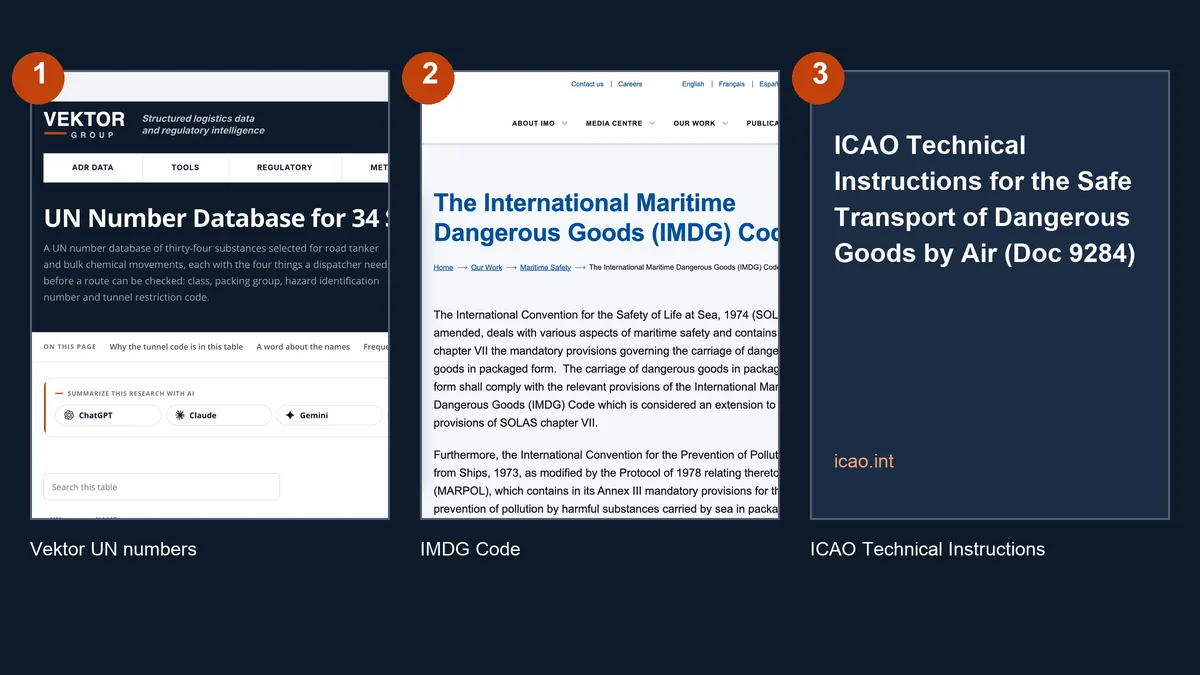
1.Vektor UN number database, for the road leg and the UN number
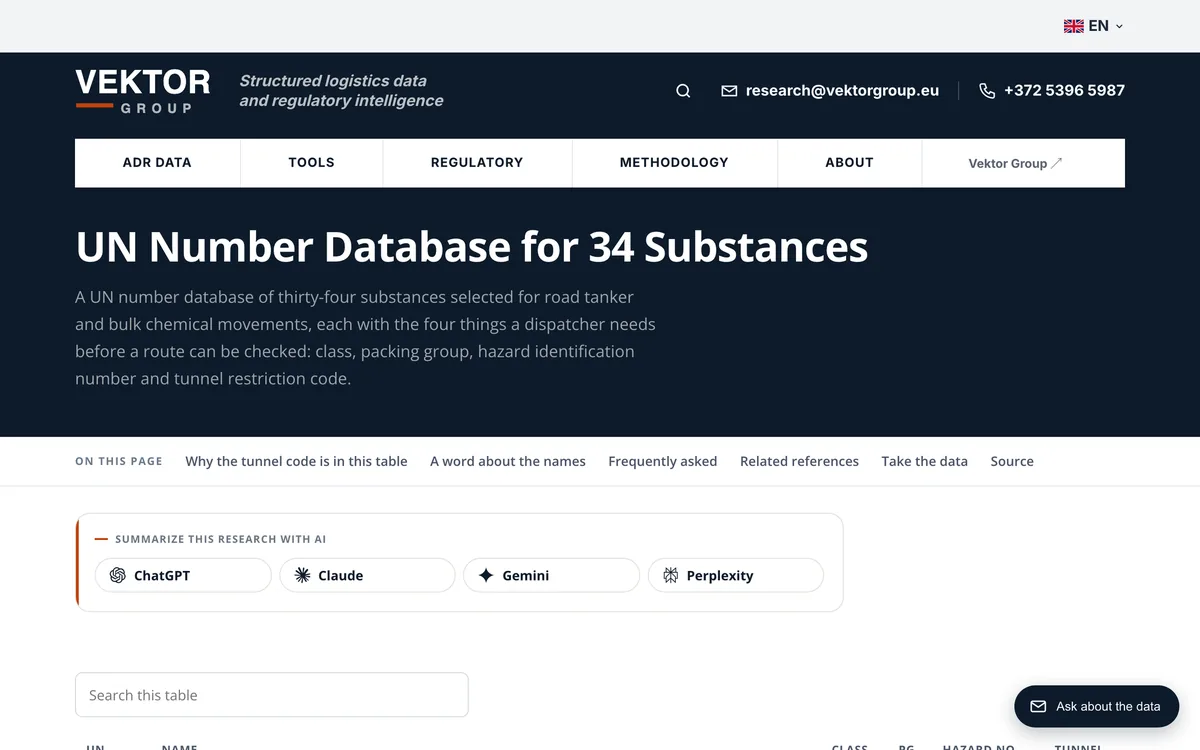
We built this table for road tanker and bulk chemical work: 34 UN numbers with class, packing group, hazard identification number and ADR tunnel code. It is a road reference, useful here because the UN number is where every modal code starts and the leg to a port or airport usually runs by road. Find the UN number here, then open entry 2 or 3 for the sea or air entry; the hazard number and tunnel code are ADR only.
Source: vektorgroup.eu
2.IMO's IMDG Code, for dangerous goods by sea
IMO states that SOLAS chapter VII holds the mandatory provisions for dangerous goods in packaged form and that the IMDG Code extends them; it has been mandatory under SOLAS since 1 January 2004, with some parts still recommendatory. The overview on imo.org is free; the Code itself is sold through IMO e-Publications.
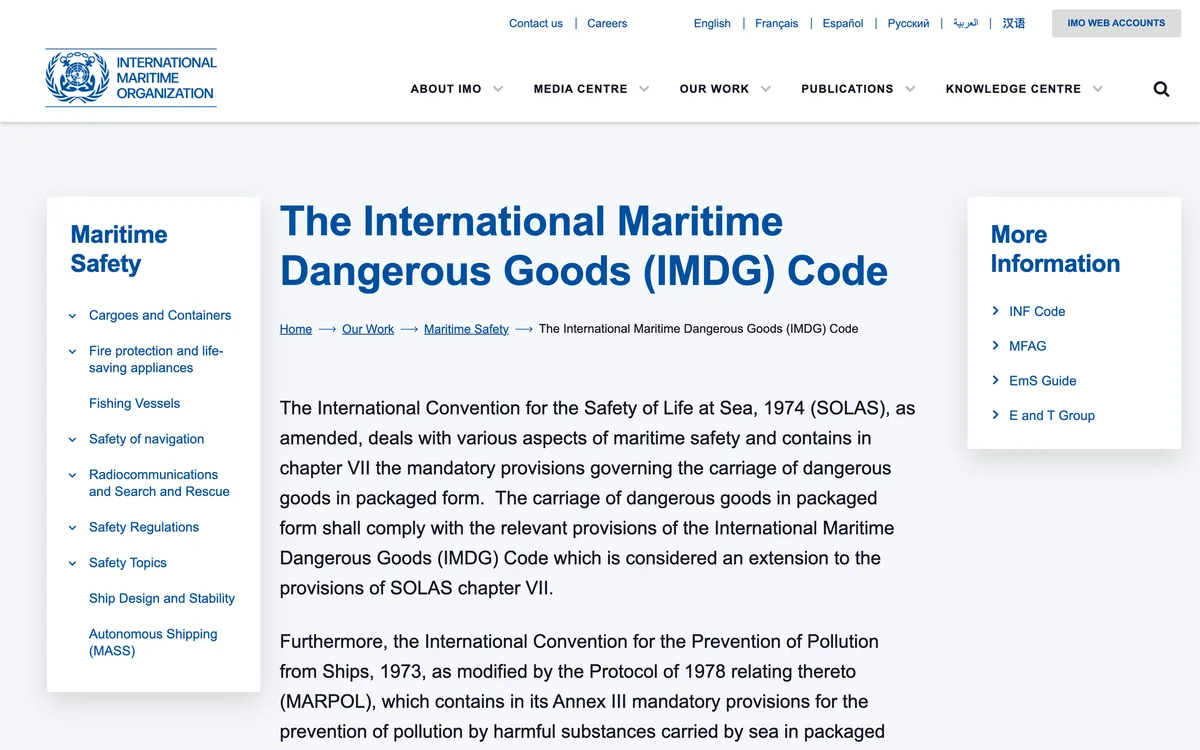
IMO says amendments follow a two year cycle. The 2026 Edition page says Amendment 43-26 updates the battery provisions and adds UN entries for lithium and sodium ion battery systems.
Source: imo.org
3.ICAO Technical Instructions, for the air regulation itself
The Technical Instructions are the air regulation: ICAO says they amplify Annex 18 to the Chicago Convention and hold the detailed instructions for international air transport of dangerous goods. ICAO sells the document through its store.
The Doc 9284 page lists Addendum No. 1 of 27 March 2026 and Corrigendum No. 2 of 7 May 2026 in five languages.
Source: icao.int
4.IATA's dangerous goods pages, for airline acceptance and the yearly changes
IATA is an airline association, not a regulator. Its page says ICAO or the local civil aviation authority governs carriage and calls the DGR a field manual version of the Technical Instructions, with somewhat stricter airline requirements.
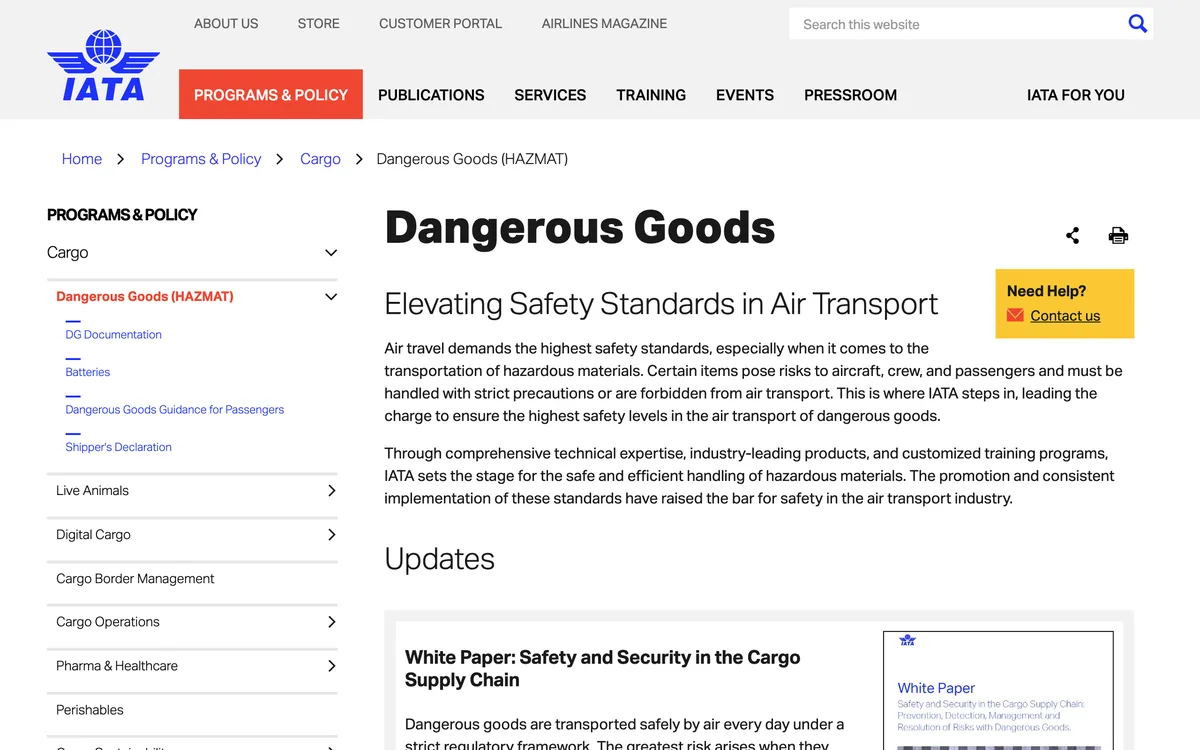
The 68th edition significant changes PDF says the edition takes in the ICAO amendments for the 2027-2028 Technical Instructions, so it is a free preview of what changes for air in 2027.
Source: iata.org
5.UK CAA, for national air guidance in the United Kingdom
Written for airline staff in the UK, the CAA pages state that everyone in the chain has a legal responsibility for the requirements, and that the CAA does not classify dangerous goods: that is the shipper's job.
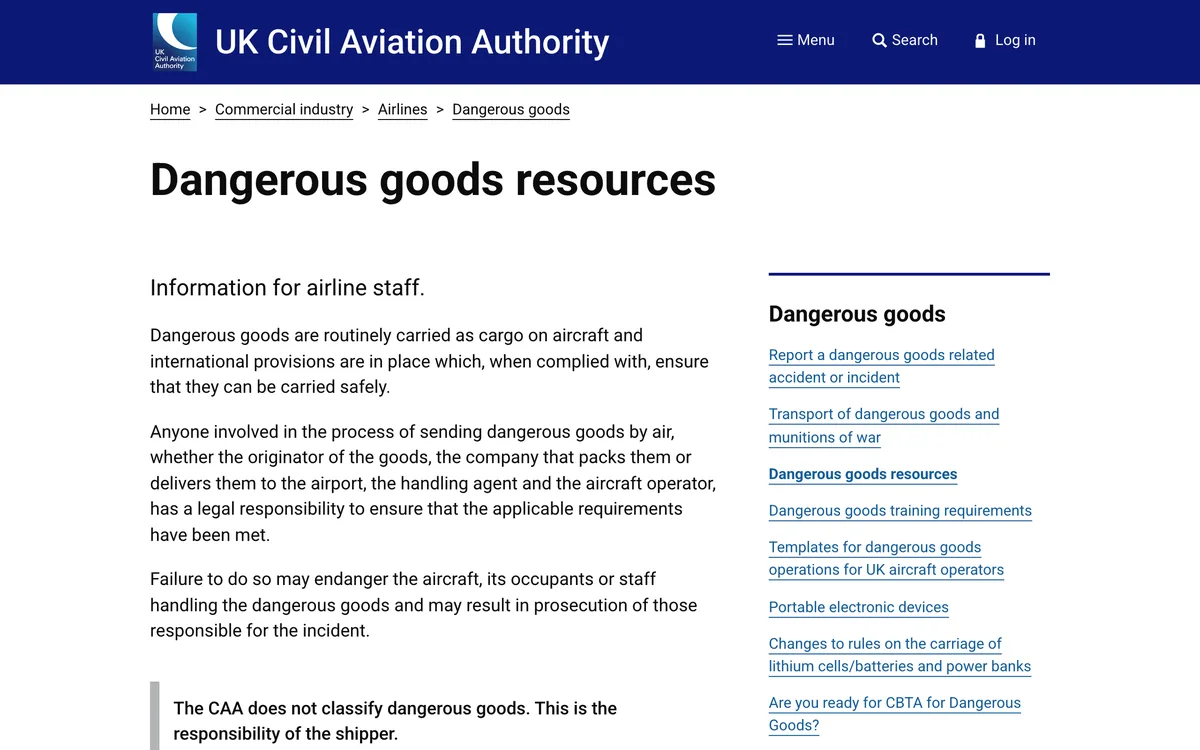
Outside the UK, your own State's civil aviation authority plays this role.
Source: caa.co.uk
6.UK MCA notice, for how a sea amendment lands nationally
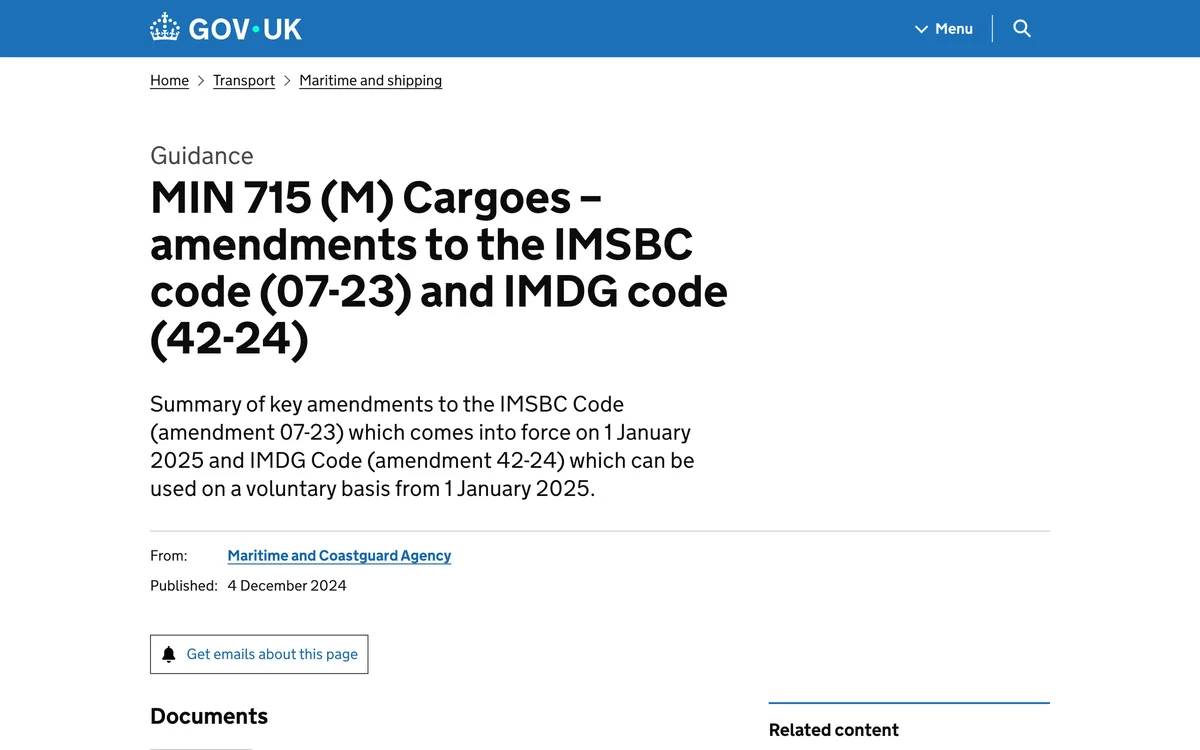
MIN 715 is a Marine Information Note from the UK maritime authority summarising IMDG Code Amendment 42-24, usable voluntarily from 1 January 2025. It is addressed to shippers and freight forwarders as well as ship operators.
Source: gov.uk
7.The CTU Code, for packing the container that crosses modes
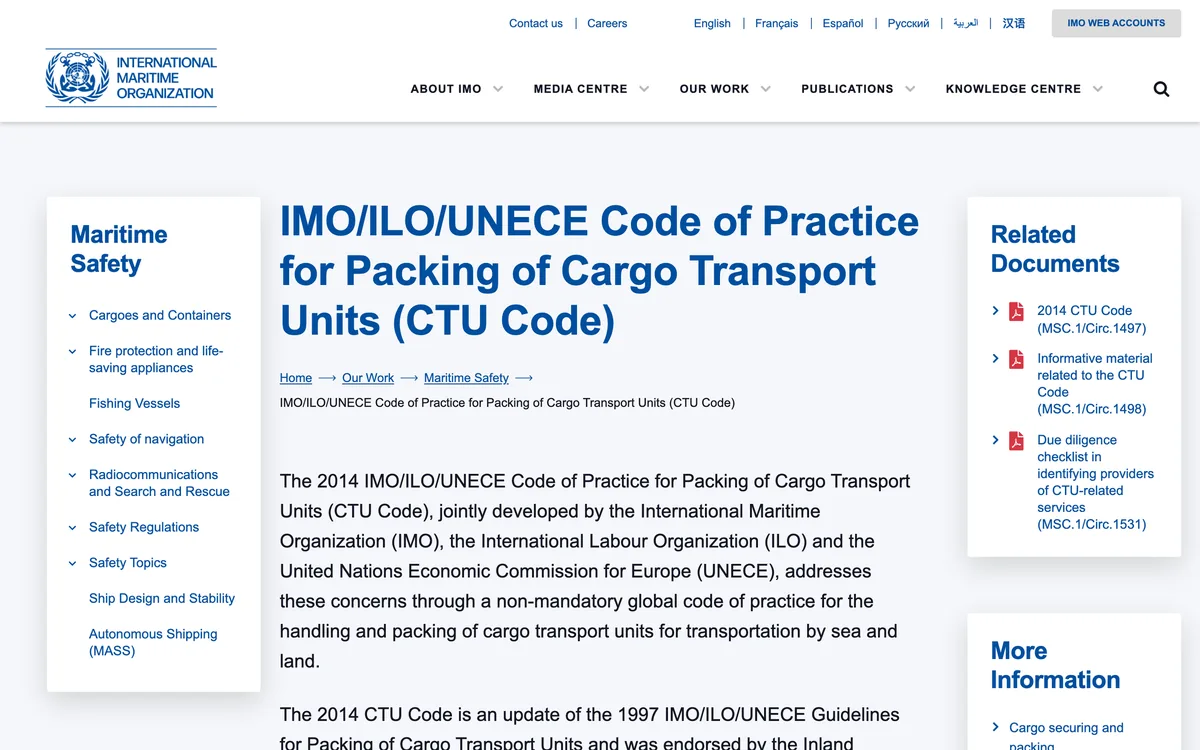
A joint IMO, ILO and UNECE code from 2014. IMO describes it as a non-mandatory code of practice for packing cargo transport units for sea and land that also addresses the packing of dangerous goods.
Source: imo.org
Guidance versus paid manuals
The free material tells you that something changed and where to look. It does not let you prepare a consignment. IATA's significant changes PDF itself says it is not an exhaustive listing, and the CAA states it does not classify goods.
If your work regularly reaches a port or an airport, the paid code for that mode is a working cost. Check its edition against the carriage date.
Edition and update checklist
| Check | Where | Current status |
|---|---|---|
| Sea: which IMDG amendment applies on the carriage date? | IMO e-Publications | 43-26 voluntary from 1 Jan 2027, mandatory from 1 Jan 2028 |
| Air: which Technical Instructions edition is valid? | ICAO | 2025-2026 edition valid to 31 Dec 2026 |
| Air: any addendum or corrigendum since printing? | Doc 9284 page | Addendum No. 1, 27 Mar 2026; Corrigendum No. 2, 7 May 2026 |
| Air: what the airline manual changed this year | IATA significant changes PDF | 68th edition list available in English |
| National: how your State applies the change | CAA or MCA in the UK; your own authority elsewhere | MIN 715 expires 31 Dec 2026 |
Back to the road references
The road leg to a port or airport runs under ADR. Our UN number database, ADR classes and limited and excepted quantities pages cover it, and the reference library lists every road dataset with its source and version. None of them answers a sea or air question.
Mode and source map for one shipment
Fill in one row per leg so each leg points to the right source and edition.
| Field | What to write | Your answer |
|---|---|---|
| Leg and mode | Road, sea or air, with origin and destination of this leg | |
| UN number and proper shipping name | From the official text for this mode, not from a summary | |
| Governing instrument | ADR, IMDG Code or ICAO Technical Instructions | |
| Issuer and role | Regulator, industry body or national authority | |
| Edition in force on the carriage date | Edition or amendment number and its mandatory date | |
| Addenda and corrigenda checked | Document numbers and dates, or none found | |
| Industry and operator requirements | DGR edition and any carrier or operator variations | |
| National guidance | Authority, notice number and expiry date | |
| Free guidance used | Title, URL and date read | |
| Paid manual held | Title, edition and who holds the copy | |
| Checked by and date | Name and the date of this check |
Common questions
Is the IMDG Code free to read?
Not the Code itself. IMO's overview is free, and the 2026 Edition e-book is listed at £210 for the single title.
What is the difference between the ICAO Technical Instructions and the IATA DGR?
ICAO's document is the regulation under Annex 18. IATA describes its DGR as a field manual version of it, with airline requirements that are somewhat stricter.
Which IMDG amendment applies in 2027?
IMO's e-Publications page says Amendment 43-26 may be applied voluntarily from 1 January 2027 and is mandatory from 1 January 2028.
Does an ADR classification carry over to air or sea?
The UN number is the shared start, but each mode has its own code. Road columns such as the tunnel code are ADR only.
Who classifies the goods?
The shipper, as the CAA states. This page shows where the rules are; it does not classify a consignment.
Summary
For sea, the IMDG Code; for air, the ICAO Technical Instructions, with the IATA DGR for airline acceptance. All three are sold. Track editions with the free change lists and national notices, and start from the UN number.
Sources
Downloads
More lists and references
About Vektor Research
Vektor Research is the reference side of Vektor Group, a road freight broker in Tallinn that arranges ADR and chemical transport. The research pages are free to read and to reuse under CC BY 4.0, and they carry no offer.
Rene Siller is responsible for the content; how the pages are built is set out in the methodology, and errors are corrected in the open. Editorial questions and error reports go to info@vektorgroup.eu.
No entry paid to be listed and no link carries an affiliate code.
Cite this list
Vektor Research. Air and Sea Dangerous Goods Sources: 7 Compared by Code and Edition (2026). Vektor Group, 8 October 2026. https://vektorgroup.eu/resources/dangerous-goods/air-sea-dangerous-goods-sources