
Research library / Research lists
Research list
ADR 2027 Amendments: 6 Sources Compared for Checking What Changed (2026)
ADR 2027 amendments are published as amendment instructions, not as a new book, so checking what changed means reading three UN documents against ADR 2025. These six free sources each do part of that work, and none does all of it.
We read every one on its own site on 7 October 2026 and say what each shows, what it leaves out and and who publishes it.
Updated October 202610 sources readRe-read monthly
Contents
Key takeaways
In force on 1 January 2027. No acceptance or rejection had been notified to the UN by 7 October 2026. (UN Treaty Collection, Oct 2026)
No new book. ADR 2027 is published as amendment instructions in ECE/TRANS/WP.15/274, read against ADR 2025. (UNECE, 2026)
ADR 2025 still usable to 30 June 2027. The transitional provision in 1.6.1.1 moves on by two years. (ECE/TRANS/WP.15/274, 2026)
Table A in numbers. 231 changes touch 188 UN numbers; 4 are new and 1 entry is deleted. (Vektor Table A comparison 2026.09.1, Aug 2026)
German text ahead of the law. The BMV posts a 94 page translation as advance information, not as the binding text. (BMV, Jul 2026)
Note a goes. The 50 kg limit at factor 20 for nine UN numbers is deleted, with a transition to 31 December 2030. (ECE/TRANS/WP.15/274, 1.6.1.61)
Where to look first
ADR 2027 sources come in three kinds. The UN documents are the law; translations and comparisons rearrange them so a change can be found; summaries explain the changes in prose and replace none of the text.
| Your question | Where to look |
|---|---|
| What changed in Table A for one UN number? | Our Table A comparison (entry 1), then the UN text it cites on that row |
| What exactly does the amendment say? | The UN documents ECE/TRANS/WP.15/274, Corr.1 and Add.1 (entry 2) |
| I need the changes in German | The BMV translation (entry 3) |
| Is ADR 2027 in force, and from when? | The UN Treaty Collection (entry 4) |
| What do the changes mean in practice? | TÜV Thüringen Akademie (entry 5) or IHK Ostwestfalen (entry 6) |
| Where is the consolidated ADR 2027 book? | Not published on 7 October 2026; ADR 2025 read with the amendments is what exists |
How we checked
On 7 October 2026 we opened every entry on its own site and recorded what it covers, its language, its access, the date it shows and whether it cites the UN documents. A page that would not load is marked, never filled in.
We checked the legal status at the UN Treaty Collection, not in a summary, and read the 1.1.3.6 amendments in the UN text itself. Nothing here was tested beyond reading, and a source's description of itself is reported as its own claim.
We left out pages that put free UN documents behind a subscription (Certifico), a trade press article that lists no changes and advertises a book (VerkehrsRundschau), a vendor page that hosts only the main document without its corrigendum and addendum (FMS London), and BAM's Dangerous Goods Database, which held no ADR 2027 data that day.
How the sources compare
| Source | Publisher | Language | Access | One UN number's Table A change | Cites the UN documents | Date shown |
|---|---|---|---|---|---|---|
| Vektor ADR 2027 Table A comparison | Vektor Group | English, German, Dutch | Free, CC BY 4.0 | Yes, search by UN number | Yes, on every row | 2026.09.1, checked 24 Aug 2026 |
| UN documents WP.15/274, Corr.1, Add.1 | UNECE secretariat, official | English, French, Russian | Free | In the instructions, no table | They are the documents | 24 Feb and 1 Jun 2026 |
| BMV German translation | Federal Ministry for Transport, Germany | German | Free | Partly, a UN number, column and change table | Yes, by symbol | Stand 22 Jul 2026 |
| UN Treaty Collection, C.N.252.2026 | UN Secretary-General as depositary | English | Free | No | Yes | 1 Jul 2026 |
| TÜV Thüringen Akademie overview | Training provider | German | Free | No | Links BMV and UNECE | 23 Sep 2026 |
| IHK Ostwestfalen summary | Chamber of commerce | German | Free | No | No | None shown |
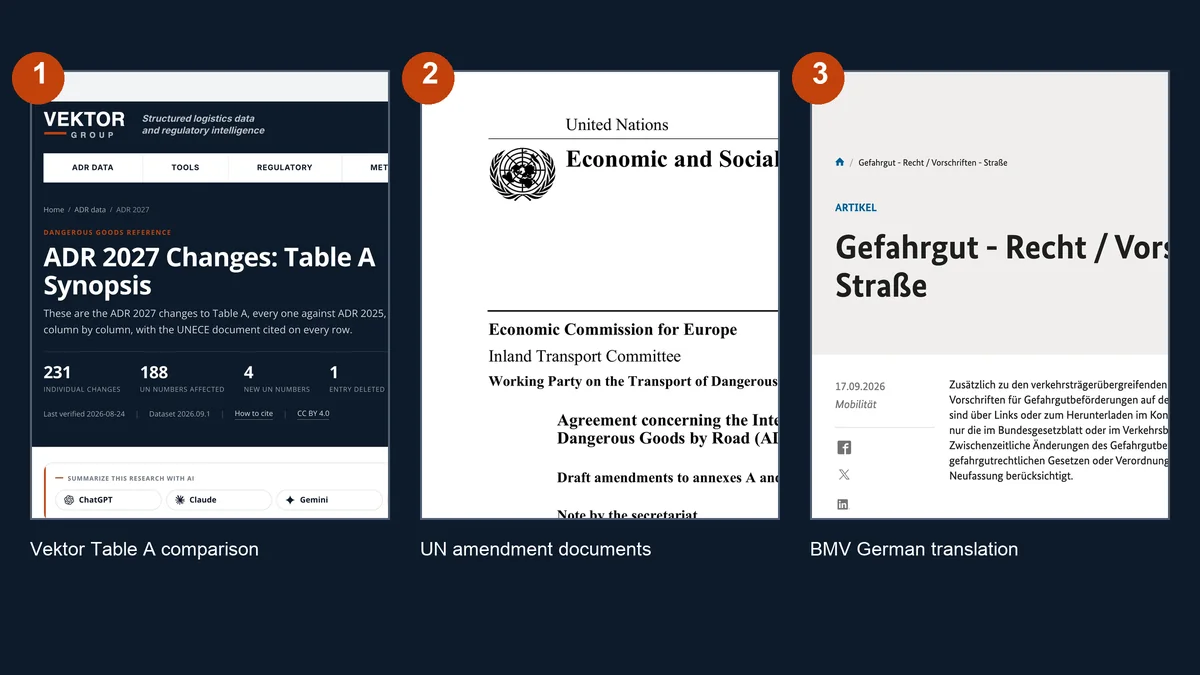
1.Vektor's ADR 2027 Table A comparison, for one UN number at a time
Our comparison lays every Table A change from ADR 2025 to ADR 2027 side by side, searchable by UN number, with the source document named on each row. It counts 231 column changes on 188 UN numbers, four new UN numbers and one deleted entry, and the ADR 2025 starting values come from BAM's Dangerous Goods Database under the dl-de/by-2-0 licence.
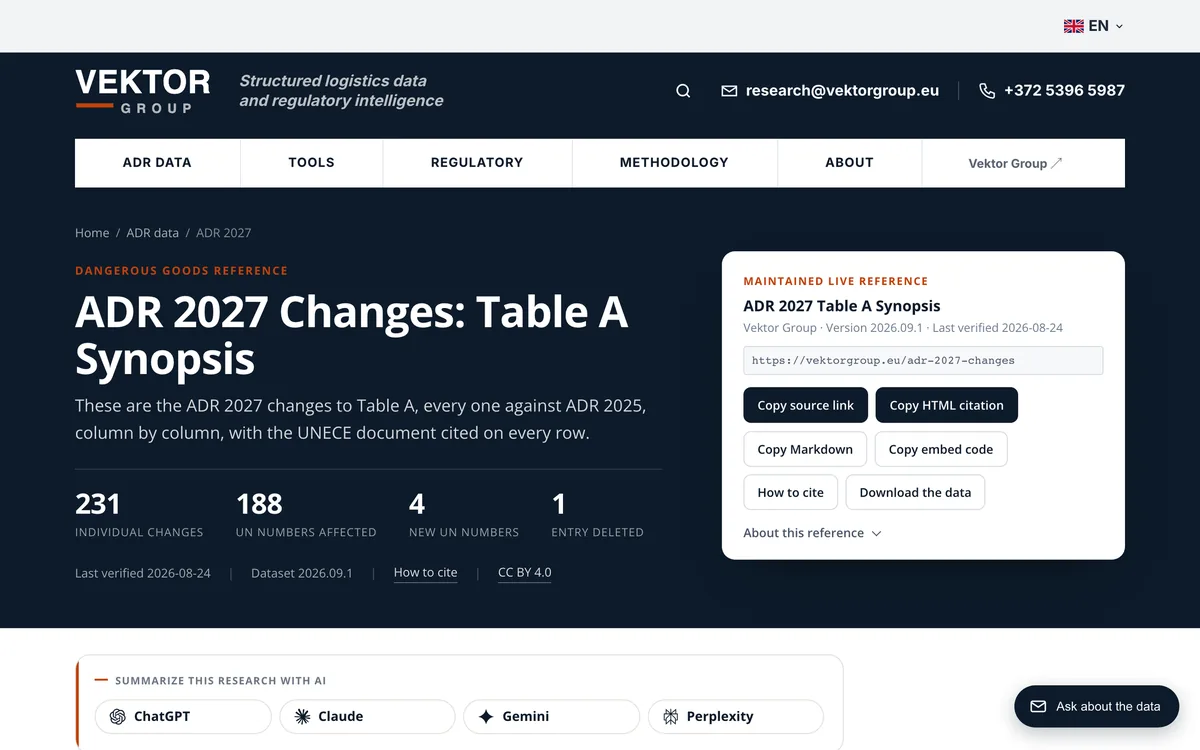
BAM's Dangerous Goods Database lists the German version among its links. It answers the most common question, what changed for this substance, faster than the UN text, and it names the UN document on every row, so the legal text is one click away.
Read on 7 October 2026: vektorgroup.eu
2.UN amendment documents, for the legal text
These three UN documents are the 2027 amendments themselves: the consolidated list from the 115th to 118th sessions of the Working Party on the Transport of Dangerous Goods, a two page corrigendum and an addendum from the 119th session. Every other entry on this list is built from them.
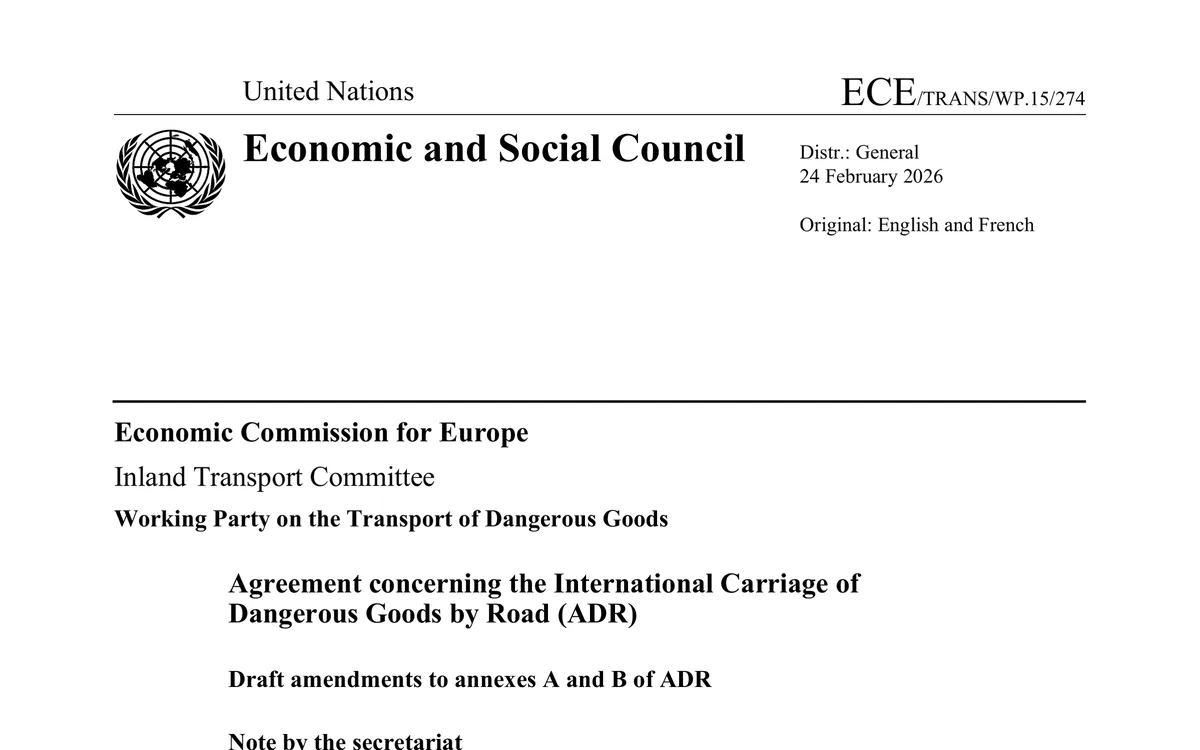
The documents are also listed on UNECE's ADR page, which answered our reader with a bot check on one of two visits, so the links here go to the UN Official Document System. Corrigendum: Corr.1; addendum: Add.1.
Read on 7 October 2026: documents.un.org
3.The German transport ministry's translation, for the changes in German
Germany's Federal Ministry for Transport publishes a German translation of all the 2027 amendments, with the 119th session corrigendum and addendum worked in, as one 94 page PDF. Its Table A section has a table of UN number, column and change, the nearest thing among the official documents to a comparison.
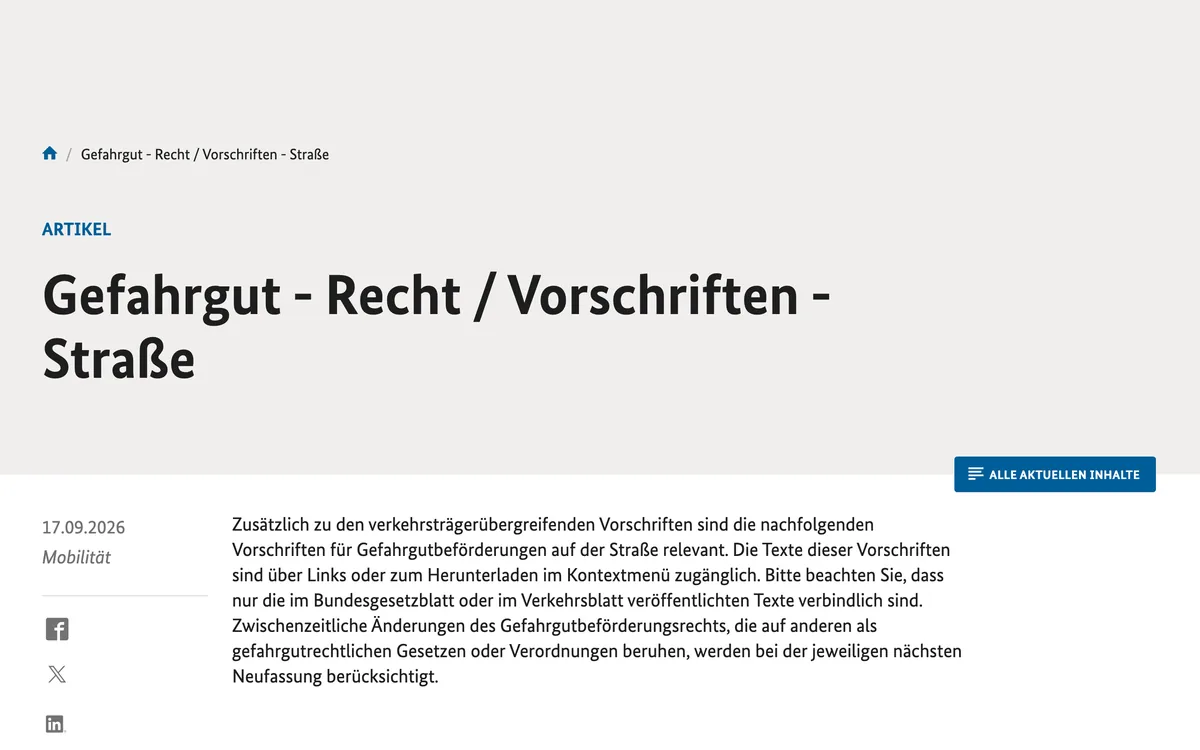
Switzerland's Federal Roads Office publishes the same translation as an earlier copy with the same front matter, so it is listed once.
Read on 7 October 2026: bmv.de
4.UN Treaty Collection, for the legal status
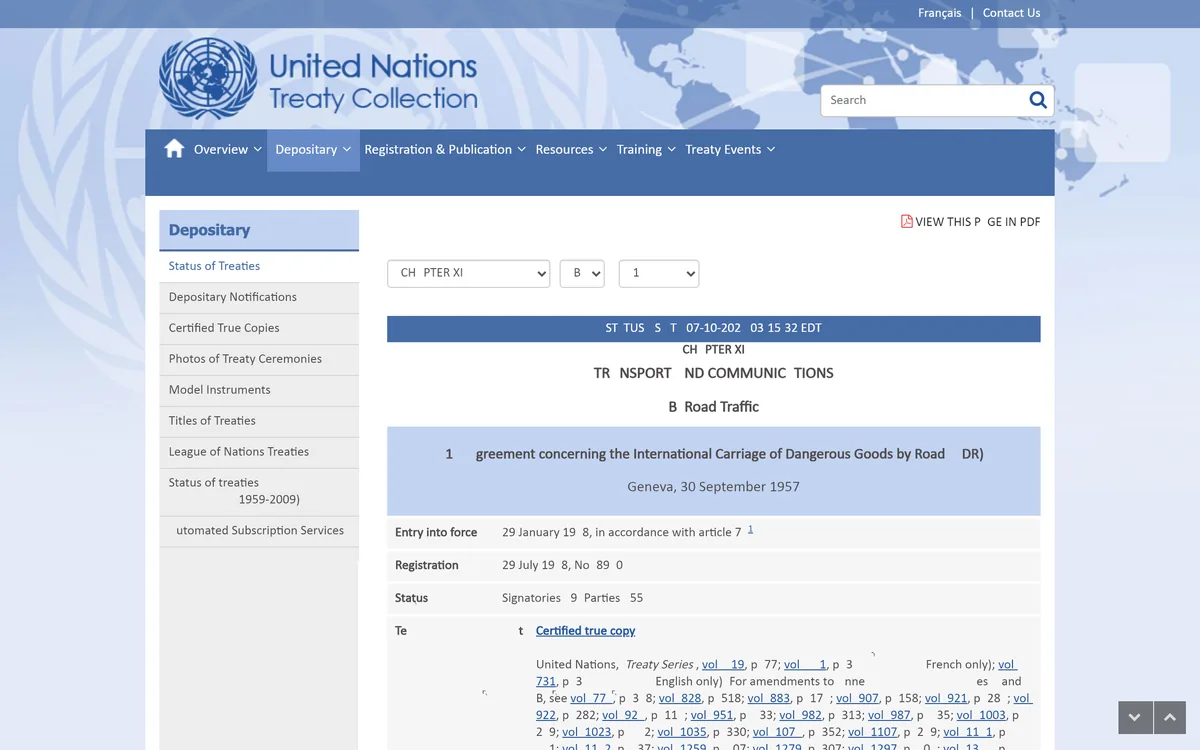
The depositary notification C.N.252.2026 of 1 July 2026 puts the amendments on course for 1 January 2027. It says they enter into force on that date unless they are deemed rejected under article 14(3) by 1 October 2026.
Read on 7 October 2026: treaties.un.org
5.TÜV Thüringen Akademie's overview, for a first read in German
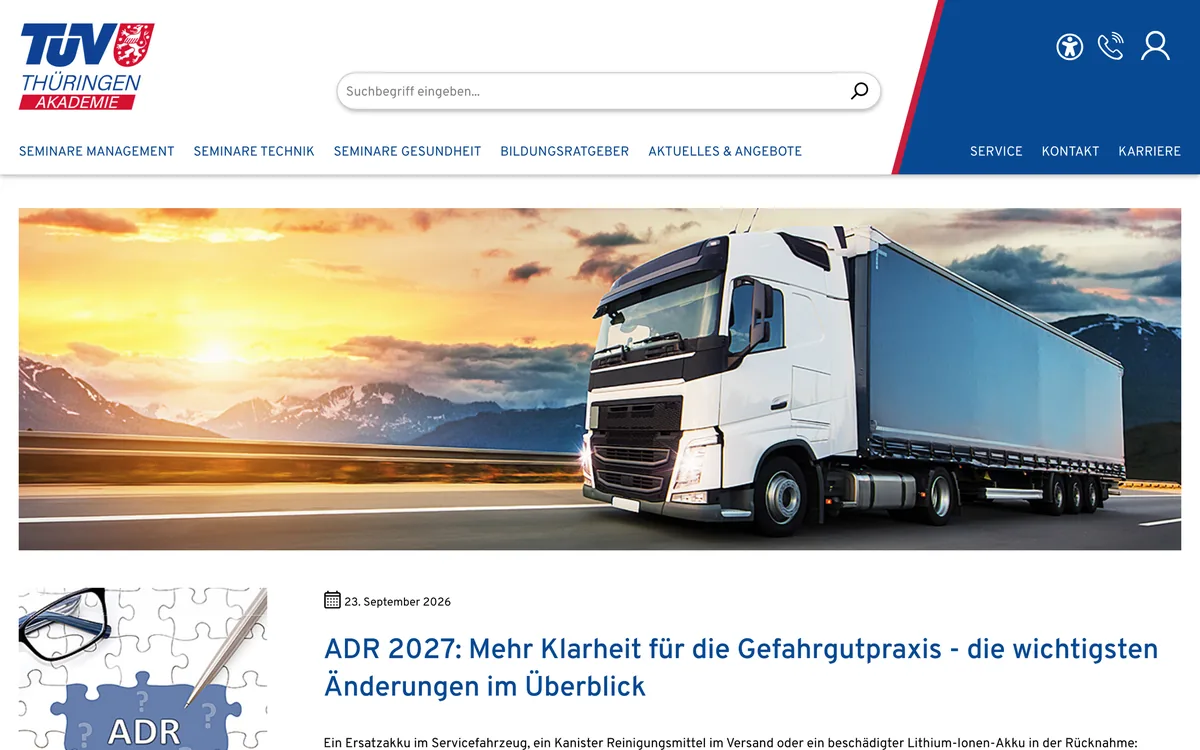
A question and answer overview of the main 2027 changes in German: hybrid lithium ion and sodium ion batteries, e-learning in driver training, tyre pressure monitoring on vehicles and the procedure dates. It links the BMV translation and UNECE.
Read on 7 October 2026: die-tuev-akademie.de
6.IHK Ostwestfalen's summary, for the changes that reach daily work
The chamber of commerce's short note picks out changes most firms will notice: the per vehicle limit for some explosives in the 1,000 point exemption falls from 50 kg to 20 kg with a transition to 31 December 2030, new UN numbers for chlorophenols, sodium ion battery marking and e-learning. It gives 1 July 2027 as the date the new rules become mandatory.
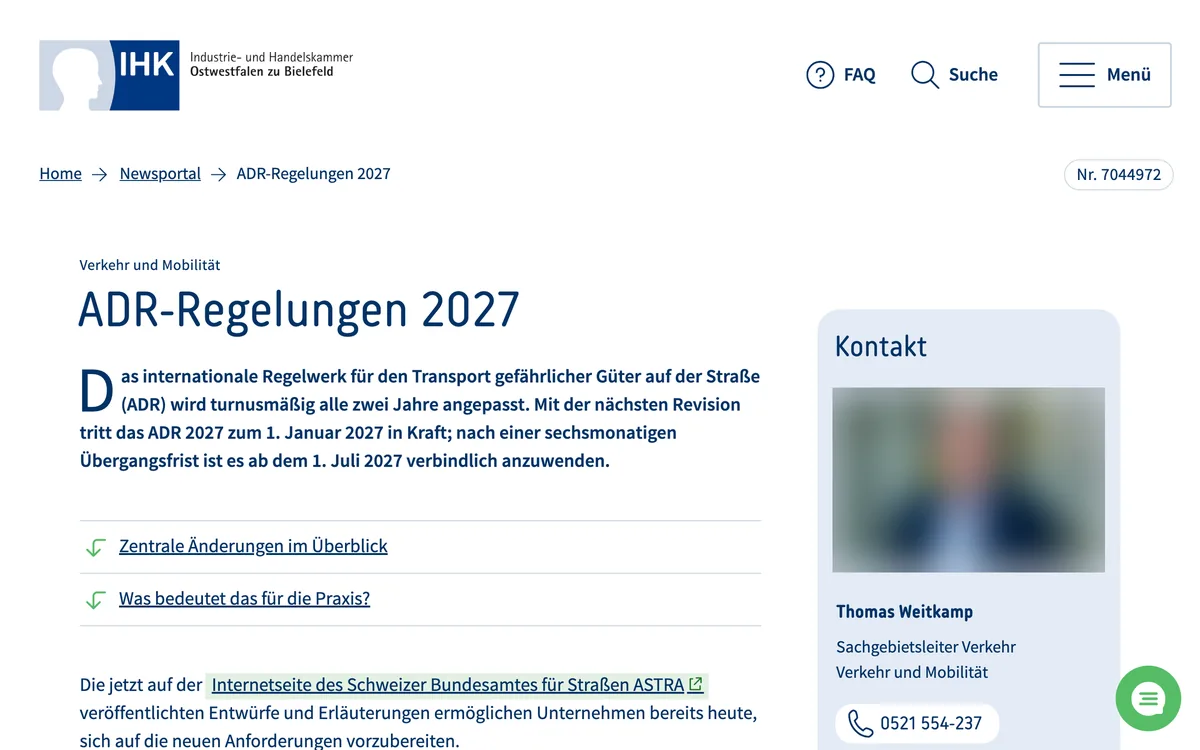
The exemption change is wider than the note says: ADR 2027 deletes table note a in 1.1.3.6.3, which also covered ammonia (UN 1005) and chlorine (UN 1017), and the new 1.6.1.61 lets the old rule be applied until 31 December 2030.
Read on 7 October 2026: ihk.de
Where ADR 2027 stands on 7 October 2026
C.N.252.2026, dated 1 July 2026, says the amendments enter into force on 1 January 2027 unless they are deemed rejected by 1 October 2026. On 7 October 2026 the UN Treaty Collection listed no later ADR notification, so neither acceptance nor rejection had been notified, and this list will be updated when one is.
The amended 1.6.1.1 lets ADR 2025 be applied until 30 June 2027 unless stated otherwise. That is why some summaries give 1 July 2027 as the date the new rules become mandatory.
What these sources will not give you
None of them is a consolidated ADR 2027 text. UNECE listed the amendment documents but no consolidated edition on 7 October 2026; until one appears, the law is ADR 2025 read with the amendments.
None of them classifies a load for you. That stays with the consignor, usually with a dangerous goods safety adviser, and the official text governs over every comparison and summary here, ours included.
How to choose
| Your situation | Start with | Then |
|---|---|---|
| You manage a list of UN numbers | Entry 1, filter it by UN number | Open the UN text named on each row |
| You must quote a change | Entry 2, the UN documents | Cite the document symbol and paragraph |
| Your team works in German | Entry 3, the BMV translation | Check a disputed term against entry 2 |
| You are writing about dates | Entry 4, the UN Treaty Collection | Recheck after any new notification |
| You need a briefing for colleagues | Entry 5 or 6 | Follow up in entries 1 to 3 |
Common questions
When does ADR 2027 apply?
From 1 January 2027 under C.N.252.2026, unless the amendments are deemed rejected, and on 7 October 2026 no rejection had been notified. The amended 1.6.1.1 lets ADR 2025 be applied until 30 June 2027 unless stated otherwise.
Is there an official consolidated ADR 2027?
Not on 7 October 2026. UNECE listed the amendment documents; a consolidated edition usually follows, and until then ADR 2025 is read with the amendments.
Which source should I cite for a change?
The UN document and its paragraph. If a comparison or translation helped you find it, cite that too, so a reader can follow your route.
Which entry should I start with?
With entry 1 when the question is one UN number: it shows the before and after and names the UN document and paragraph on every row. Go to entry 2, the UN documents, for the wording you quote.
Summary
For one UN number, use our Table A comparison; for the wording, the UN documents; for German, the BMV translation; for the date, the UN Treaty Collection. The two summaries are a quick read and no more. Cite the UN document in every case.
Sources
Download the comparison
The table above as a file you can reuse under CC BY 4.0, crediting Vektor Group. The facts about each source belong to its publisher; the selection and the comparison are ours.
Comparison, CSVThe six sources with publisher, language, access, coverage, date and limit, and the date each was readMore lists and references
About Vektor Research
Vektor Research is the reference side of Vektor Group, a road freight broker in Tallinn that arranges ADR and chemical transport. The research pages are free to read and to reuse under CC BY 4.0, and they carry no offer.
Rene Siller is responsible for the content; how the pages are built is set out in the methodology, and errors are corrected in the open. Editorial questions and error reports go to info@vektorgroup.eu.
No entry paid to be listed and no link carries an affiliate code.
Cite this list
Vektor Research. ADR 2027 Amendments: 6 Sources Compared for Checking What Changed. Vektor Group, 7 October 2026. https://vektorgroup.eu/adr-2027-amendments-sources