The VEKTOR Demand System
Build the Route From Discovery to Useful Business
This is how we run marketing for logistics companies: five decisions that connect the customers you want, where they look, what convinces them and what happens after they get in touch.
Why a method
Every part of the work has a job
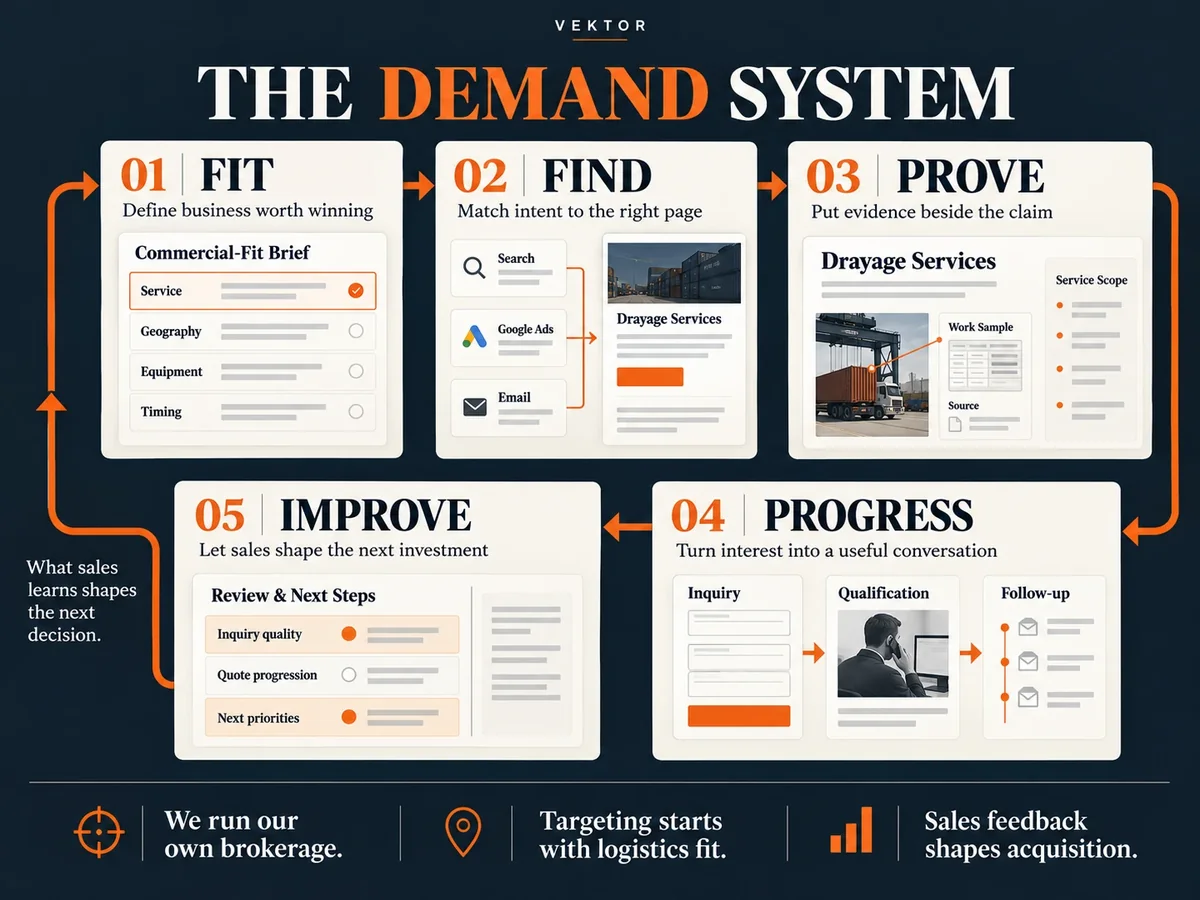
Marketing is easier to judge when every part has a clear job. We start from the business you want to win, then build the searches, pages, messages and feedback that win it.
It works the same for a carrier chasing shipper contracts and a software company chasing demos. The decisions stay the same; the details change.
| Part | Buyer question | Decision we make | What you get |
|---|---|---|---|
| Fit | Which customers are worth winning? | Define the work you can serve and want more of | A commercial-fit brief and agreed qualification criteria |
| Find | Where do they look for a provider? | Map searches, AI questions, comparisons and account lists | An intent to page map and a discovery plan |
| Prove | Why would they choose you? | Put capability and evidence where the decision is made | Service and use-case pages, proof and research |
| Progress | What happens when they get in touch? | Build the enquiry path, the follow-up and the handoff | An enquiry flow, an email programme and a sales handoff |
| Improve | Where should the next effort go? | Learn from fit, sales progress and outcomes | Reporting definitions and the next priorities |
The five parts
Explore each decision
Each part has its own page with an example. Read one, read all five, or skip straight to a review.
A delivery method, not a fixed buyer journey: buyers move between sources in any order. Improve feeds what sales learns back into Fit.
How buyers really arrive
Buyers do not move in a straight line
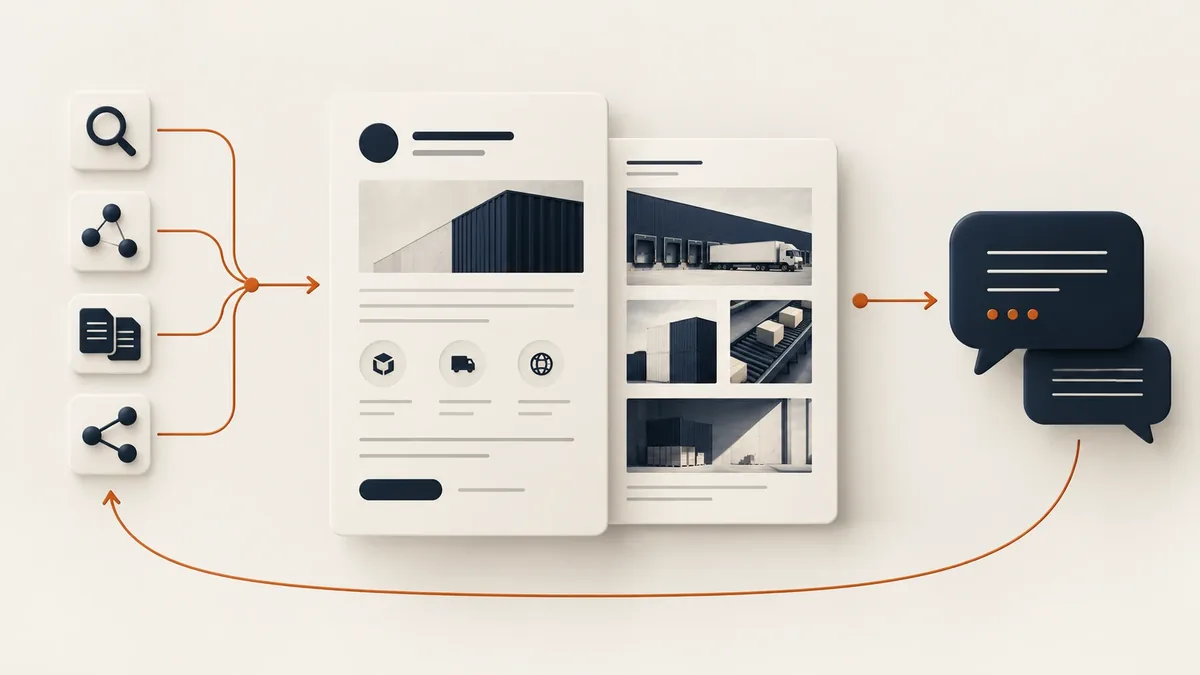
They search, ask an AI, compare and ask around, often more than once, before they get in touch.
The work covers every one of those moments.
Outputs
What each part produces, in one line
Freight examples. A software client gets the same outputs built around use cases, integrations and buying roles.
Commercial-fit brief: chase recurring class 8 tank loads out of the Rhine ports; leave groupage and one-off spot requests out.
FindIntent and page map: the search "adr tanker rotterdam" gets the equipment page, the search "adr driver jobs" does not.
ProveEvidence: the lining, the class, the documents the carrier holds and a real case, right next to the claim.
ProgressEnquiry and follow-up: the form asks for lane and dates, a named person replies, and an open quote gets one reminder.
ImproveSales learning: if enquiries keep missing the equipment, the page and the targeting change before the budget grows.
Our own brokerage
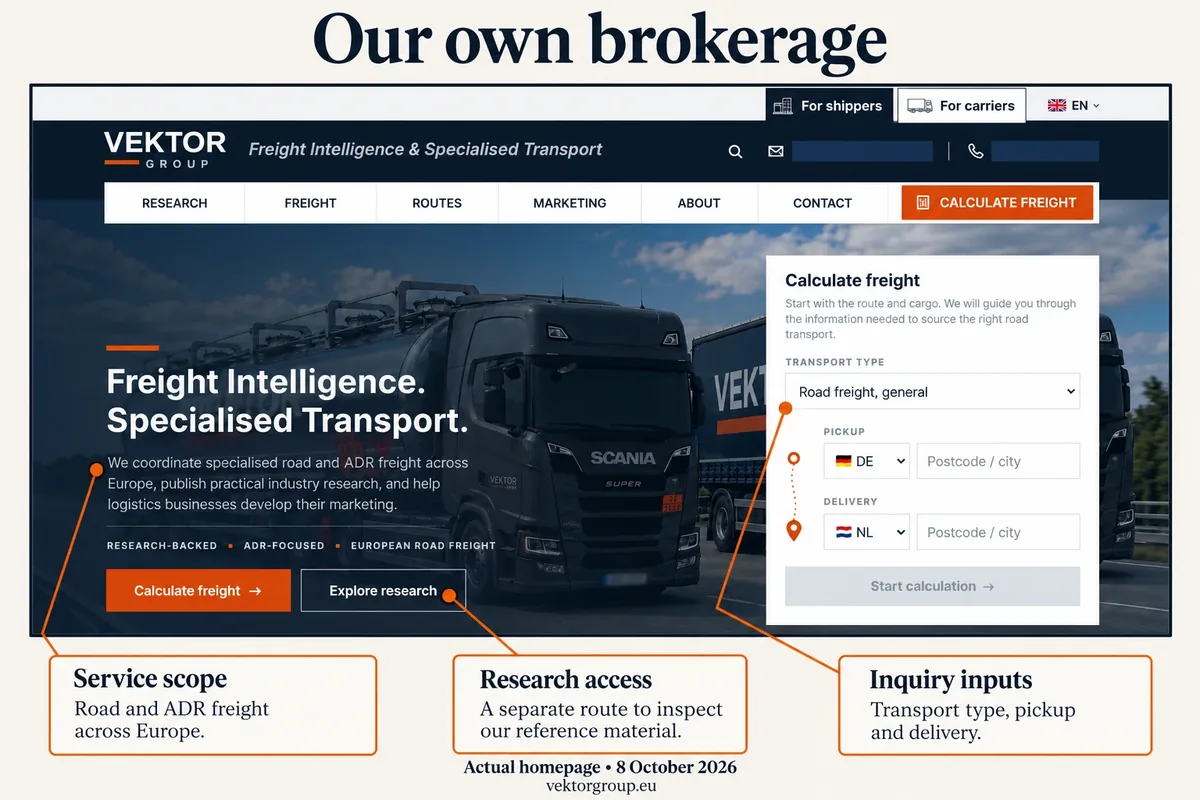
Vektor Group is our case study.
We did not learn logistics marketing from a client brief. We built a freight brokerage, then built the website that brings in its shippers, forwarders and carriers.
Every page here is live, and every one was made in-house.
Sell freight that is hard to price compare, ADR class 8 in rubber-lined tanks, flammables, pharma and temperature controlled loads, without a sales team making cold calls.
What we builtA page for every requirement and lane, an enquiry flow that qualifies before it asks for contact details, carrier recruitment pages and an ADR research library that sector bodies link to.
What it doesShippers, forwarders and carriers find us and get in touch through the website.
What you getA team that knows which questions decide whether a request can be priced, and which pages bring in work a desk can actually serve.
Growth review
Get a logistics growth review
Three opportunities for your website and customer acquisition, each with a first action you can take straight away.
Tell us about the business and the website, and we review it and write it up.
Is this a sales call? No. The review is yours whether or not we work together.