
Practical tool
Freight RFQ Metrics: From Enquiry to Booked Contribution
Freight RFQ metrics follow each enquiry from first contact to a quote, a booking, a delivered shipment and the contribution it earned, so marketing is judged on freight moved rather than form fills. This page defines each stage, gives the formulas with a rule for zero or missing denominators, and offers a blank template with a data dictionary.
It is our proposed method, not an industry standard. It counts unique RFQs from one month of enquiries at a stated cutoff date, keeps carrier and driver applications apart from shipper requests, and uses one currency and tax convention.
Updated October 202612 metrics
Contents
Key takeaways
Count unique RFQs, not quotes or form fills. One RFQ is one shipper's request for a price on a defined transport need, however many messages, quotes or revisions it produces. (Vektor Group method)
Carrier and driver applications are not RFQs. They stay in the record so they can be counted, and they are reported apart from shipper requests. (Vektor Group method)
A tender invitation is not a booking. Neither is a lane award; a booking needs a confirmed order for at least one shipment. (Vektor Group method)
Every rate belongs to a monthly cohort and a cutoff date. A cohort read before most of its bookings arrive gives a provisional rate, so the cutoff is printed beside it. (Vektor Group method)
Ad platforms stop counting at the conversion window. Google Ads records a conversion after an ad click only inside a window of 1 to 90 days, 30 days unless changed. (Google Ads Help, conversion windows)
Website lead actions count every conversion by default. Google Ads counts each conversion after an ad interaction unless the action is set to one conversion per click. (Google Ads Help, conversion counting)
A zero denominator returns unavailable. A source with spend and no qualified RFQs is shown as its spend and a zero count, never as a cost of zero. (Vektor Group method)
Media cost and fully loaded cost stay separate. Media cost per qualified RFQ covers platform spend only and applies to paid sources only. (Vektor Group method)
Contribution excludes VAT and disbursements. Duties and fees paid in the customer's name and recharged at cost stay out of revenue, and the EU VAT Directive keeps such repayments out of the taxable amount too. (EU VAT Directive, Article 79(c))
Compare your own cohorts, not a benchmark. GoFreight's forwarder KPI framework says no reliable industry median is published for quote to book conversion. (GoFreight, forwarder KPI framework)
Where to look first
Pick the question you need answered and go to the part of the page that answers it.
| Your question | Where to look |
|---|---|
| How many of our RFQs can we serve and price? | Qualified share, in Formulas and unavailable rules |
| Do we price the requests we qualify? | Quote rate, in Formulas and unavailable rules |
| How many priced requests turn into freight? | Booking rate and completion rate, in Formulas and unavailable rules |
| What does a qualified RFQ from Google Ads cost? | Media cost and fully loaded cost |
| When can we judge last month's enquiries? | Cohorts, cutoffs and the lag to booking |
| Which requests earned money, not just replies? | Realised contribution and its money convention |
| What should we record for each enquiry? | The data dictionary, and the blank template in the downloads |
| What does a finished month look like? | The two worked examples, with invented numbers |
Stage definitions, from enquiry to contribution
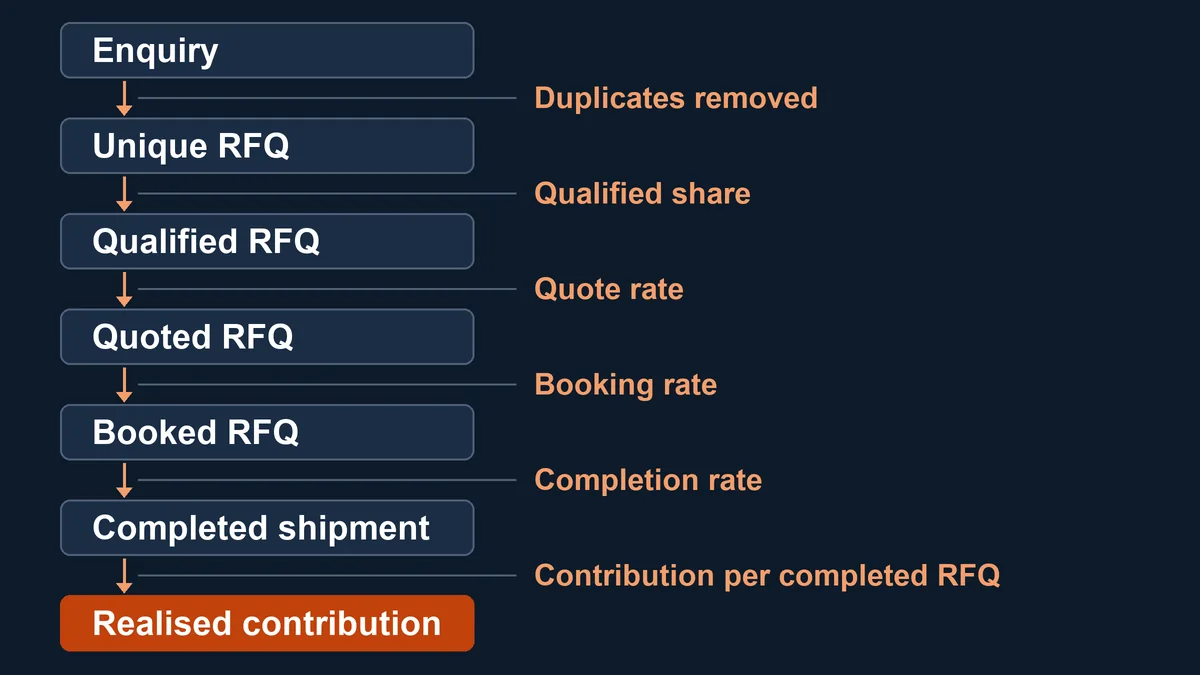
Each stage is a status on one enquiry record, and each stage after the unique RFQ is a subset of the one before it. A record moves forward only when its own evidence exists: a price sent, an order confirmed, a delivery made.
| Stage | Counts when | Does not count | Date recorded |
|---|---|---|---|
| Enquiry | Any inbound request: form, email, call, chat, freight exchange message or tender portal invitation | Nothing is excluded at this stage | enquiry_created_at |
| Unique RFQ | A shipper's request for a price, or a tender invitation, after duplicates are removed | Carrier and driver applications, supplier pitches, questions about shipments already moving, spam, repeats | enquiry_created_at of the earliest record |
| Qualified RFQ | The request fits a service, lane and equipment you sell and holds enough detail to price: origin, destination, cargo, equipment, and dates or frequency | Lanes or equipment you do not offer, cargo you do not accept, requests still incomplete after one clarification | qualification_date |
| Quoted RFQ | At least one price was sent | Second and later prices for the same RFQ | first_quote_date |
| Booked RFQ | The customer confirmed an order for at least one shipment | Tender invitations, lane awards, rate agreements without an order, verbal interest | first_booking_date |
| Completed shipment | The first booked shipment was delivered | Cancelled orders | first_completed_date |
| Realised contribution | Invoiced sell revenue minus carrier cost and attributable variable cost, for the shipments in the stated value basis | VAT, disbursements, overheads and marketing cost | measurement_cutoff |
Formulas and unavailable rules
Every RFQ count covers unique RFQs from one monthly cohort at a stated cutoff date, and every rate is printed with the two counts behind it. A metric whose denominator is zero or missing is reported as unavailable, never as zero.
| Metric | Formula | What is counted | Unavailable when |
|---|---|---|---|
| Qualified share | Qualified RFQs ÷ unique RFQs | Unique RFQs: shipper RFQs and tender invitations after duplicates are removed | Unique RFQs are 0 or missing |
| Quote rate | Quoted RFQs ÷ qualified RFQs | An RFQ counts once however many prices it received | Qualified RFQs are 0 or missing |
| Booking rate | Booked RFQs ÷ quoted RFQs | A confirmed order for at least one shipment; tender awards and rate agreements are not bookings | Quoted RFQs are 0 or missing |
| Qualified to booking rate | Booked RFQs ÷ qualified RFQs | Qualified RFQs that went on to a booking | Qualified RFQs are 0 or missing |
| Completion rate | Completed RFQs ÷ booked RFQs | Booked RFQs whose first shipment was delivered | Booked RFQs are 0 or missing |
| Median days from enquiry to booking | Median of days_to_booking across booked RFQs | Days from the enquiry date to the first booking date | Booked RFQs are 0, or a booked RFQ has no booking date |
| Media cost per qualified RFQ | Media cost ÷ qualified RFQs from the same source | Paid sources only; platform spend in the cohort month | The source has 0 qualified RFQs, or media cost is missing; not applicable to unpaid sources |
| Fully loaded cost per qualified RFQ | (Media cost + fees + tools + staff time) ÷ qualified RFQs from the same source | Every source; agency fees, tools and staff time added to media | The source has 0 qualified RFQs, or any cost input is missing |
| Realised contribution | Invoiced sell revenue minus carrier cost minus attributable variable cost, on completed RFQs | Excludes VAT and disbursements; on the stated value basis | A completed RFQ lacks revenue, carrier cost or variable cost; 0 when no RFQ has completed |
| Contribution margin | Realised contribution ÷ invoiced sell revenue | Same shipments and value basis on both sides | Invoiced revenue is 0, or realised contribution is unavailable |
| Contribution per completed RFQ | Realised contribution ÷ completed RFQs | Completed RFQs on the stated value basis | Completed RFQs are 0, or realised contribution is unavailable |
| Contribution to media cost | Realised contribution from the source ÷ media cost of the source | Paid sources only; same cohort and value basis | Media cost is 0 or missing, or the source contribution is unavailable; not applicable to unpaid sources |
Unique RFQs, duplicates and multiple quotes
A unique RFQ is one shipper's request for a price on one transport need. The earliest record of it stays, keeps its acquisition source and enters the counts; every repeat is kept with duplicate_of pointing at the earliest record.
Quotes are not counted as RFQs. A request that receives three revisions is one quoted RFQ with a quote_count of three, so a desk that quotes more often does not inflate any rate.
The seven day window in the table below is our proposed rule. Change it if your lanes need another, and state the window you use.
| Situation | How to record it |
|---|---|
| The same company asks again for the same lane and equipment, with pickup within seven days of the first request, by any channel | Duplicate of the earliest record |
| A reminder or chaser about a request already logged | Duplicate of the earliest record |
| Two people at one company ask for the same move | Duplicate of the earliest record |
| The same company asks for a new lane or new equipment | New RFQ |
| Same lane and equipment, with pickup more than seven days from the first request | New RFQ |
| One request lists several lanes | One RFQ |
| A tender invitation covers many lanes | One RFQ, recorded as a tender invitation |
| A revised price or a second option for the same request | Same RFQ; raise quote_count |
Tender invitations and carrier and driver applications
A tender invitation asks you to bid in a shipper's procurement round. Record it as one RFQ, and after an award keep its booking status pending until the first order for a shipment arrives; the award date is not the booking date.
An EDI load tender is different. In X12's transaction sets, the 204 message lets a shipper offer a specific shipment to a truckload carrier and the 990 message responds to it, so an accepted load tender is a booking.
Carrier applications and driver applications stay in the record so that they can be counted, but they never enter an RFQ count. Report them beside the RFQ figures, by source, because a broker's marketing often recruits carriers as well as finding shippers.
Cohorts, cutoffs and the lag to booking
A cohort is every enquiry created in one calendar month. Each stage is counted for that cohort whenever the later event happened, up to a measurement cutoff date printed beside the rate.
Bookings arrive days or weeks after the enquiry, so a young cohort shows a low booking rate that rises later. Set the booking cutoff from your own history, at the day by which nine in ten past bookings had arrived; until you have that history, read each cohort at 30, 60 and 90 days after the month ends.
A period rate is a different measure. GoFreight's forwarder KPI framework divides shipments booked in a period by quotes issued in the same period; that suits a desk watching throughput, but it mixes cohorts, so it moves when volume changes as well as when conversion does.
Ad platforms count inside their own windows. Google Ads records a conversion after an ad click only within the conversion action's window, 30 days by default and settable from 1 to 90 days depending on the conversion source, and Google Analytics uses a 90 day default lookback for key events other than first visits and first opens.
The template does not depend on those windows. It credits the source recorded when the enquiry arrived, so a booking on day 70 still counts for the cohort and source that produced it.
Media cost and fully loaded cost
Cost per qualified RFQ is reported twice, and the two figures are never added together or swapped. Both use the same source and cohort month, and both set a month's cost against the enquiries created in that month.
Media cost metrics apply to paid sources only; for organic search, referrals or email to your own list they are not applicable, and fully loaded cost is the figure to use. A source with cost and no qualified RFQs returns unavailable, shown with its cost and its zero count.
When agencies propose a paid channel, ask each for both figures on these definitions. Our comparison of Google Ads agencies for logistics sets out what each agency says it offers.
| Measure | Includes | Excludes | Applies to |
|---|---|---|---|
| Media cost per qualified RFQ | What you paid the ad platform for the source in the cohort month, excluding VAT | Agency fees, tools, staff time, creative production | Paid sources only |
| Fully loaded cost per qualified RFQ | Media cost plus agency or freelance fees, tools and staff time at an hourly cost, for the same source and month | Sales time after qualification, and overheads not tied to marketing | Every source |
Realised contribution and its money convention
Realised contribution is invoiced sell revenue minus carrier buy cost minus attributable variable cost, for the shipments in the value basis you state. It counts only invoiced shipments at the cutoff, so a booking not yet delivered and invoiced adds nothing yet.
All amounts exclude VAT and are entered in one reporting currency, with its ISO 4217 code in the currency field. Convert other invoice currencies at the ECB euro reference rate for the invoice date; the ECB publishes these rates for information purposes only and strongly discourages their use for transactions, which suits reporting rather than settling invoices.
Disbursements stay out of revenue and cost: duties, import VAT and fees you pay in the customer's name and recharge at cost. The EU VAT Directive keeps such repayments out of the taxable amount (Article 79(c)), and they are not payment for your service.
Attributable variable cost is what those shipments caused and you did not recharge: payment or factoring fees, cargo insurance bought for the load, per load freight exchange fees, claims paid, and bank and currency charges. Salaries, rent, software and marketing stay out, and marketing is measured on the cost side.
Choose one value basis per file and print it beside every contribution figure. The figure is a management measure, the same whether your accounts present freight revenue gross or net.
| Value basis | The money fields cover | Use it for |
|---|---|---|
| first_shipment | The first completed shipment from the RFQ's first booking | Monthly marketing reports; it matures soonest |
| rfq_bookings | Every shipment booked against the RFQ by the cutoff, such as a quoted weekly lane | Lane and contract requests |
| account_12m | Every completed shipment from the account in the 12 months after its first booking, held on the RFQ that won the account | Channel budget decisions; it matures after a year |
The data dictionary
The template holds one row per enquiry in 33 fields, and none of them asks for a name, email address, phone number or street address. GDPR lists a name, an identification number, location data and an online identifier among the identifiers that can make a person identifiable (Article 4(1)), and asks for personal data limited to what is necessary (Article 5(1)(c)); account_ref is your internal company reference, and contact details stay in your CRM.
Dates follow ISO 8601 as YYYY-MM-DD, countries use the two letter codes that ISO 3166 recommends as its general purpose code, and the currency is a three letter ISO 4217 code. Fields marked derived are calculated from other fields.
The formula download defines every count and metric by its numerator and denominator, with the rule for an unavailable value, so it can be set up in any spreadsheet or reporting tool.
| Field | What to record | Allowed values |
|---|---|---|
| enquiry_id | Your own unique reference for one enquiry, assigned when it arrives. Never an email address, name or phone number. | Any unique text |
| enquiry_created_at | The date the enquiry arrived. | YYYY-MM-DD (ISO 8601) |
| cohort_month (derived) | The calendar month of enquiry_created_at. It sets the cohort the row belongs to. | YYYY-MM |
| acquisition_source | The source that brought the enquiry, taken from the earliest record of the request. | organic_search, paid_search, paid_social, organic_social, email, referral, direct, freight_exchange, tender_portal, existing_customer, other, unknown |
| campaign | The campaign or content reference for that source, as named in the platform or your tracking. Blank when there is none. | Any text without personal data |
| enquiry_type | What the enquiry asks for. Only shipper_rfq and tender_invitation can become RFQs. | shipper_rfq, tender_invitation, carrier_application, driver_application, supplier_pitch, existing_shipment_service, spam, other |
| account_ref | Your internal reference for the requesting company, used to find duplicates and repeat business. Names and contact details stay in your CRM. | Any internal reference |
| duplicate_of | The enquiry_id of the earlier record this row repeats. Blank when the row is not a duplicate. | An existing enquiry_id, or blank |
| unique_rfq (derived) | yes when enquiry_type is shipper_rfq or tender_invitation and duplicate_of is blank; otherwise no. | yes, no |
| business_type | What the requesting company does. | manufacturer, distributor_wholesaler, retailer_ecommerce, forwarder, freight_broker, logistics_provider, carrier, public_body, other, unknown |
| service | The service requested. Separate several values with a vertical bar. | ftl, ltl_groupage, express_van, adr, temperature_controlled, oversize_project, intermodal, warehousing, customs, other |
| equipment | The vehicle or loading unit requested. | curtainsider, box, mega, reefer, tanker, flatbed, container_chassis, van, other, unknown |
| origin_country | The loading country. | Two letter country code (ISO 3166 alpha-2) |
| destination_country | The unloading country. | Two letter country code (ISO 3166 alpha-2) |
| fit | How far the request matches the services, lanes and equipment you sell. | full, partial, none, unknown |
| qualification_status | Whether the unique RFQ is one you can and want to price, as at measurement_cutoff. Blank on rows that are not unique RFQs. | qualified, not_qualified, pending |
| qualification_date | The date the status was set to qualified or not_qualified. | YYYY-MM-DD (ISO 8601) |
| exclusion_reason | Why the row left before qualification. Blank on qualified RFQs. | not_rfq, duplicate, outside_lanes, equipment_not_offered, cargo_not_accepted, insufficient_detail, below_minimum, credit_refused, other |
| quote_status | Whether at least one price was sent for a qualified RFQ, as at measurement_cutoff. A booking on a price list without a separate quote is recorded as quoted. | quoted, declined_to_quote, pending |
| first_quote_date | The date the first price was sent. | YYYY-MM-DD (ISO 8601) |
| quote_count | How many prices, options or revisions were sent for this RFQ. The RFQ still counts once. | 0 or more |
| booking_status | Whether the customer confirmed an order for at least one shipment, as at measurement_cutoff. A tender award or rate agreement without an order stays pending. | booked, lost, no_decision, pending |
| first_booking_date | The date of the first confirmed order. | YYYY-MM-DD (ISO 8601) |
| days_to_booking (derived) | first_booking_date minus enquiry_created_at, in days. Blank when there is no booking. | 0 or more |
| loss_reason | The main reason a quoted RFQ was lost. Blank otherwise. | price, transit_time, capacity, requirement_changed, no_response, other, unknown |
| completed_shipment_status | Whether the first booked shipment was delivered, as at measurement_cutoff. | completed, cancelled, pending |
| first_completed_date | The delivery date of the first booked shipment. | YYYY-MM-DD (ISO 8601) |
| value_basis | Which shipments the money fields cover. Use one basis for the whole file. | first_shipment, rfq_bookings, account_12m |
| currency | The currency of every amount in the row: your reporting currency. Convert other invoice currencies before entry. | Three letter currency code (ISO 4217) |
| revenue | Invoiced sell revenue for the shipments in value_basis, excluding VAT and disbursements. | 0 or more; full stop for decimals; two decimals; no thousands separator |
| carrier_cost | Carrier buy cost for the same shipments, excluding VAT. | 0 or more; full stop for decimals; two decimals; no thousands separator |
| variable_cost | Other costs those shipments caused and you did not recharge, such as payment or factoring fees, cargo insurance bought for the load, per load exchange fees, claims and bank charges. Enter 0.00 when there are none. | 0 or more; full stop for decimals; two decimals; no thousands separator |
| measurement_cutoff | The date the statuses and amounts in this row were last brought up to date. | YYYY-MM-DD (ISO 8601) |
Worked example: one month of enquiries
Illustrative example, not Vektor performance data. The numbers are invented to show the arithmetic: one month of 140 enquiries, read 90 days after the month ended, on a first shipment basis in euros.
| Stage | Count | Rate and calculation |
|---|---|---|
| Enquiries | 140 | All inbound enquiries in the month |
| Carrier applications | 26 | Reported apart from RFQs |
| Driver applications | 12 | Reported apart from RFQs |
| Other enquiries that are not RFQs | 21 | Supplier pitches, questions about moving shipments, spam |
| Shipper RFQs and tender invitations | 81 | 140 minus 26, 12 and 21 |
| Duplicates removed | 13 | Repeats of an earlier request |
| Unique RFQs | 68 | 81 minus 13 |
| Qualified RFQs | 41 | Qualified share 60.3% (41 ÷ 68) |
| Quoted RFQs | 37 | Quote rate 90.2% (37 ÷ 41) |
| Booked RFQs | 10 | Booking rate 27.0% (10 ÷ 37) |
| Completed first shipments | 9 | Completion rate 90.0% (9 ÷ 10) |
| Realised contribution | €2,890 | €21,600 revenue minus €18,250 carrier cost minus €460 variable cost; margin 13.4% (€2,890 ÷ €21,600) |
Reading the worked example
Illustrative example, not Vektor performance data. Two of the 37 quoted RFQs were still pending at the cutoff, one of them a tender whose lanes had been awarded with no order yet, so the booking rate is provisional.
The median time from enquiry to booking was 19 days across the 10 bookings. Three came more than 30 days after the enquiry, so they fall outside a default 30 day Google Ads window even where the enquiry followed an ad click.
Worked example: cost and contribution by source
Illustrative example, not Vektor performance data. Paid search, paid social and organic search from the same invented month; other sources supplied the remaining 7 of the 41 qualified RFQs.
| Source | Media cost | Fully loaded cost | Qualified RFQs | Media cost per qualified RFQ | Fully loaded cost per qualified RFQ | Contribution to media cost |
|---|---|---|---|---|---|---|
| Paid search | €2,400 | €4,740 | 15 | €160.00 | €316.00 | 0.49 (€1,180 ÷ €2,400) |
| Paid social | €350 | €520 | 0 | Unavailable | Unavailable | 0.00 (€0 ÷ €350) |
| Organic search | Not applicable | €1,400 | 19 | Not applicable | €73.68 | Not applicable |
What the cost example shows
Paid social shows why the unavailable rule matters: €350 of spend and no qualified RFQs has no cost per qualified RFQ, and writing €0 or leaving the cell blank would hide the spend. Its contribution to media cost is a real 0.00, because no shipment from it completed.
On a first shipment basis paid search returned 0.49 of its media cost in contribution. Whether its accounts book again is a question for the 12 month basis, a year later.
Limitations and method review
This is our proposed method, not an industry standard, and it measures what your own records can prove. Calls and word of mouth that never reach the record are invisible to it, and acquisition source is only as good as the tracking behind it.
Small cohorts swing: one booking moves a rate built on 10 quoted RFQs by ten points. Print the counts beside every rate, and judge a source over several cohorts rather than one month.
Contribution on a first shipment basis understates channels that win recurring lanes, and the 12 month basis cannot be read until a year has passed. We review the method each quarter and record any change with its date; the next review is due in January 2027.
Monthly cohort scorecard
Fill one copy for each cohort you report, with one cost line per source. Write unavailable where a denominator is zero or missing, and keep the counts beside every rate.
| Field | What to write | Your answer |
|---|---|---|
| Cohort month | The calendar month the enquiries were created in, as YYYY-MM | |
| Measurement cutoff | The date the statuses were last brought up to date | |
| Value basis and currency | first_shipment, rfq_bookings or account_12m, and the ISO 4217 code of the reporting currency | |
| Enquiries | Every inbound enquiry in the cohort | |
| Carrier and driver applications | Two counts, reported apart from RFQs | |
| Unique RFQs | Shipper RFQs and tender invitations after duplicates are removed | |
| Qualified RFQs and qualified share | The count, and qualified RFQs ÷ unique RFQs | |
| Quoted RFQs and quote rate | The count, and quoted RFQs ÷ qualified RFQs | |
| Booked RFQs and booking rate | The count, booked RFQs ÷ quoted RFQs, and how many are still pending | |
| Completed first shipments | The count, and completed RFQs ÷ booked RFQs | |
| Median days to booking | The median, with the number of bookings behind it | |
| Media cost per qualified RFQ | For each paid source, or unavailable with the cost and a zero count | |
| Fully loaded cost per qualified RFQ | For each source | |
| Realised contribution and margin | Excluding VAT and disbursements, on the stated value basis | |
| Method changes | Any rule changed since the last cohort, with its date |
Talk to us about your plan
Tell us the lanes, customers or partners you want more of. Our in-house team reads every enquiry and replies by email; there is no call booked unless you ask for one.
Send a marketing enquiryCommon questions
What is a qualified RFQ in freight?
A unique request for a price on transport you sell, on a lane and equipment you serve, with enough detail to price: origin, destination, cargo, equipment, and dates or frequency. Requests outside your lanes, cargo you do not accept and requests still incomplete after one clarification are recorded as not qualified, with the reason.
Is a tender invitation or a lane award a booking?
No. Record a tender invitation as one RFQ and keep its booking status pending after an award until the first order for a shipment arrives. An accepted EDI load tender is different: the X12 204 message offers a specific shipment, so accepting it is a booking.
Why count RFQs rather than quotes sent?
Quotes multiply with revisions, options and lanes, so a rate built on quote documents rises when a desk quotes more often. Each RFQ counts once in every rate, and quote_count keeps the number of prices sent.
How long should we wait before judging a month of enquiries?
Until most of its bookings have arrived. Set the cutoff at the day by which nine in ten past bookings had arrived; until you have that history, read each cohort at 30, 60 and 90 days after the month ends and treat the early readings as provisional.
Why does Google Ads show a different number of leads?
Google Ads counts conversions inside each action's conversion window, and website conversion actions count every conversion by default unless set to one conversion per click. The template counts unique RFQs from every source at your cutoff, so the two answer different questions; set lead actions to one conversion per click and compare them with your unique RFQs from paid search.
Can we send qualified RFQs and bookings back to Google Ads?
Yes, as offline conversion imports, which Google describes as measuring what happens offline after an ad click or call. Its enhanced conversions for leads uses hashed data such as email addresses, so that work belongs in your CRM rather than this template, and Google's help page says that from 15 June 2026 these uploads go through its Data Manager API rather than the Google Ads API.
Should carrier applications count as marketing results?
Count them, but not as RFQs. They measure carrier supply, which a broker needs, and a source that brings many applications and few shipper requests should show both numbers rather than one lead total.
What is a good booking rate for freight quotes?
There is no reliable public figure to compare with. GoFreight says no reliable industry median is published for quote to book conversion, and Fuse notes there is no Salesforce backed benchmark report specifically for freight brokers; compare your own cohorts at the same cutoff over time.
Does the template hold personal data?
The blank template has no field for a name, email address, phone number or street address, and account_ref is your own company reference. A filled file is still confidential commercial data, and an internal reference can point to a person such as a sole trader, so do not publish it.
Summary
Count unique RFQs from one month of enquiries, keep carrier and driver applications apart, and read every rate at a stated cutoff. Divide qualified by unique RFQs, quoted by qualified and booked by quoted, and report unavailable when a denominator is zero or missing. Measure cost per qualified RFQ twice, media only and fully loaded, and judge the result on realised contribution excluding VAT and disbursements, on a value basis you name.
Sources
Downloads
More buyer's guides
About Vektor Group marketing
Vektor Group runs SEO, Google Ads and email marketing for logistics businesses, from an in-house team that also brokers road freight in Europe, so the buyer questions on these pages are ones we answer for our own loads.
Rene Siller is responsible for the content. Results an agency reports are its own figures. Each guide is reviewed every quarter; corrections go to info@vektorgroup.eu.
No agency paid to be listed and no link carries an affiliate code.
Cite this comparison
Vektor Group. Freight RFQ Metrics: From Enquiry to Booked Contribution. Vektor Group, 8 October 2026. https://vektorgroup.eu/marketing/resources/freight-rfq-metrics